5 Checks Prop Traders Need in a Master Account Failover Runbook

Promote a vetted backup master only after confirming ownership and live connectivity, pausing new trade entries, and arming the kill switch and per-account caps. Skip any of those three checks and a master account failover turns a routine promotion into orphaned trades and blown drawdown limits across every follower account tied to that leader.
TL;DR:
- Confirm ownership, test connectivity, and arm safety controls before promoting a backup master to prevent orphaned trades and limit risks.
- Run promotion within a scheduled window, use small test trades, and have a rollback plan ready to quickly revert if issues arise.
- Perform post-promote reconciliation checks on net positions, orphan trades, and multiplier settings to ensure successful switching without drift.
- Enforce strict risk controls like kill switches, maximum lot caps, and automated alerts to contain errors during and after failover.
- Conduct regular demo drills of the entire failover process to identify weaknesses and build confidence before applying to live accounts.
Table of Contents
- Pre-Failover Checklist: Verify Before You Switch
- Step-by-Step Failover Procedure for a Change Window
- Verification and Reconciliation After Promotion
- Risk Controls to Enforce During and After Failover
- How Do You Test a Failover Without Risking a Funded Account?
- Governance: Who Approves and Executes a Failover?
- What Failover Drills Actually Teach You
- Test Your Failover Runbook Before You Need It
- Sources
Pre-Failover Checklist: Verify Before You Switch
A rushed promotion is how ghost positions happen. Before you touch the copier settings, run through five checks in order.
- Ownership and compliance. Confirm the backup master account is owned and controlled by the trader or firm, not a third party. Most prop firms treat an externally owned master account as a rules violation regardless of how clean the technical setup looks. Document the approval if your firm requires sign-off.
- Live connectivity. Verify the copier status shows green, API sessions are active, and your VPS or cloud connection is healthy on both the outgoing master feed and every follower link.
- Balance and multiplier snapshot. Record current balances, margin usage, and contract multipliers for the master and each follower before you do anything else.
- Kill switch armed. Confirm the kill switch is configured and tested, and set hard max-lot caps on followers so a bad tick can’t cascade.
- Communication plan. Know who gets notified, how escalation works, and where the operating log lives.
Pro Tip: Write the pre-state snapshot into your log before you touch anything. A one-line entry showing balances and multipliers at T-minus-zero is what lets you measure drift five minutes later instead of guessing at it.
Step-by-Step Failover Procedure for a Change Window
Run this sequence inside a defined change window, not in the middle of a fast market if you can help it.
- Notify and pause. Alert stakeholders, freeze new trade entry workflows, and pull up your monitoring dashboards so you can watch fills in real time.
- Choose your strategy. Decide between flatten-all (close everything, start clean on the new master) or sync-net (carry positions through) based on follower states and any prop-firm position limits in play.
- Execute the switch. Put followers into protected or pause mode, promote the backup master inside the copier, then reapply per-account lot caps and recalculate proportional scaling for the new balance and multiplier.
- Run the small test trade. Confirm order replication with one small position before you trust the setup with size. Watch rejection logs and fill parity closely.
- Roll back if it breaks. Have a scripted fallback ready: re-promote the old master or flatten followers, and trigger the kill switch immediately if mismatches look severe.
The mode you’re running matters here. Executions Mode copies only confirmed fills, which tends to improve entry parity but adds a beat of delay. Orders Mode places independently and lets each follower manage its own exit, which is faster but leaves more room for drift during a switch. Know which mode you’re on before you promote, because it changes what “normal” looks like in your test trade.
Watch for this: practitioner reports consistently point to unmatched “ghost” positions as the most common failure when a leader switch happens without a rehearsed reconciliation step. A five-minute checklist run immediately after promotion catches most of them before they compound.
Verification and Reconciliation After Promotion
Promotion isn’t finished until reconciliation confirms it worked. Three checks, done in order, catch almost every failure mode.
- Net-position comparison. Pull a comparison report between the new master and every follower. Flag any delta beyond your tolerance band, even a small one.
- Orphan trade detection. Query for trades that exist on a follower with no matching master position. These usually trace back to a follower that was mid-fill when the switch happened, or a symbol mapping mismatch that slipped through the checklist.
- Multiplier recheck. Recalculate contract-multiplier or lot-scaling wherever the numbers don’t line up, then verify the margin impact on each follower again. A new master’s balance can shift follower sizing the instant it’s promoted, and that shift can push a follower straight past its drawdown limit if nobody rechecks it.
Log every reconciliation step. A short post-event report, timestamped and specific, is what turns a stressful afternoon into a documented process improvement instead of a story nobody wants to repeat.
Pro Tip: Set your tolerance band before the failover, not during it. Deciding in the moment what counts as an “acceptable” delta is how small mismatches get waved through.
Risk Controls to Enforce During and After Failover
The controls below aren’t optional extras. They’re what keeps one bad promotion from becoming an account-ending event.
- A working kill switch that can pause copying and, if needed, close positions across every follower at once.
- Hard max-lot caps and per-account limits that stop oversized replication before it starts, not after you notice it.
- Proportional-scaling recalibration and minimum-hold filters checked any time follower balances differ materially from the master.
- Automated alerts for rejected orders, unusual slippage, or drawdown thresholds, so you find out from a notification instead of a phone call.
- Never promote an externally owned account as master if your prop firm prohibits third-party masters. This is a compliance line, not a technical preference, and ownership verification is the check that protects the account regardless of how solid the setup otherwise looks.
Pro Tip: Test your kill switch on a demo account monthly. A control nobody has actually triggered in six months is a control you don’t really have.
How Do You Test a Failover Without Risking a Funded Account?
Test in stages, on demo, before you ever touch a live promotion.
- Run demo tests covering the full trade lifecycle: open, modify, partial close, and full close across multiple symbols. A safe setup checklist that skips lifecycle testing tends to miss the exact edge cases that show up during a real switch.
- Stage the rollout. Test with one follower first, then a small subset, then your full live group.
- Record fill parity, rejection rate, and timing differences against thresholds you set in advance.
- Schedule recurring emergency drills and update the runbook after every one, even the ones that go smoothly.
Governance: Who Approves and Executes a Failover?
A role matrix keeps a stressful moment from becoming a confused one.
- Separation of duties. Define who can approve a promotion, who executes it, who observes, and who escalates if something goes wrong.
- Authorization thresholds. Set different sign-off requirements for a planned promotion versus an emergency one, with contact points for each.
- Log fields. Every entry needs a timestamp, the actor, a pre-state snapshot, the action taken, reconciliation notes, and a post-state snapshot.
- Compliance notification. Know in advance when and how your prop firm or compliance owner needs to hear about the switch. Reviewing your firm’s account delegation policies ahead of time saves a scramble later.
What Failover Drills Actually Teach You
A rehearsal we ran caught a scaling mismatch before it ever touched a live follower, purely because the drill forced a five-minute check sequence nobody would have run under real pressure. The three mistakes operators repeat most: skipping the ownership check, promoting without a tested kill switch, and treating reconciliation as optional once the trade looks fine on the surface. A short operating log paired with fast alerts is the single habit that shrinks recovery time more than any other control on this list.
— KennyTrades
Test Your Failover Runbook Before You Need It
This kind of trade copier provides an operational layer that includes a kill switch to pause or close positions across followers instantly, per-account lot caps, real-time push notifications for rejections or slippage, and supports multiple prop-firm platforms to allow master and follower accounts on different brokers.
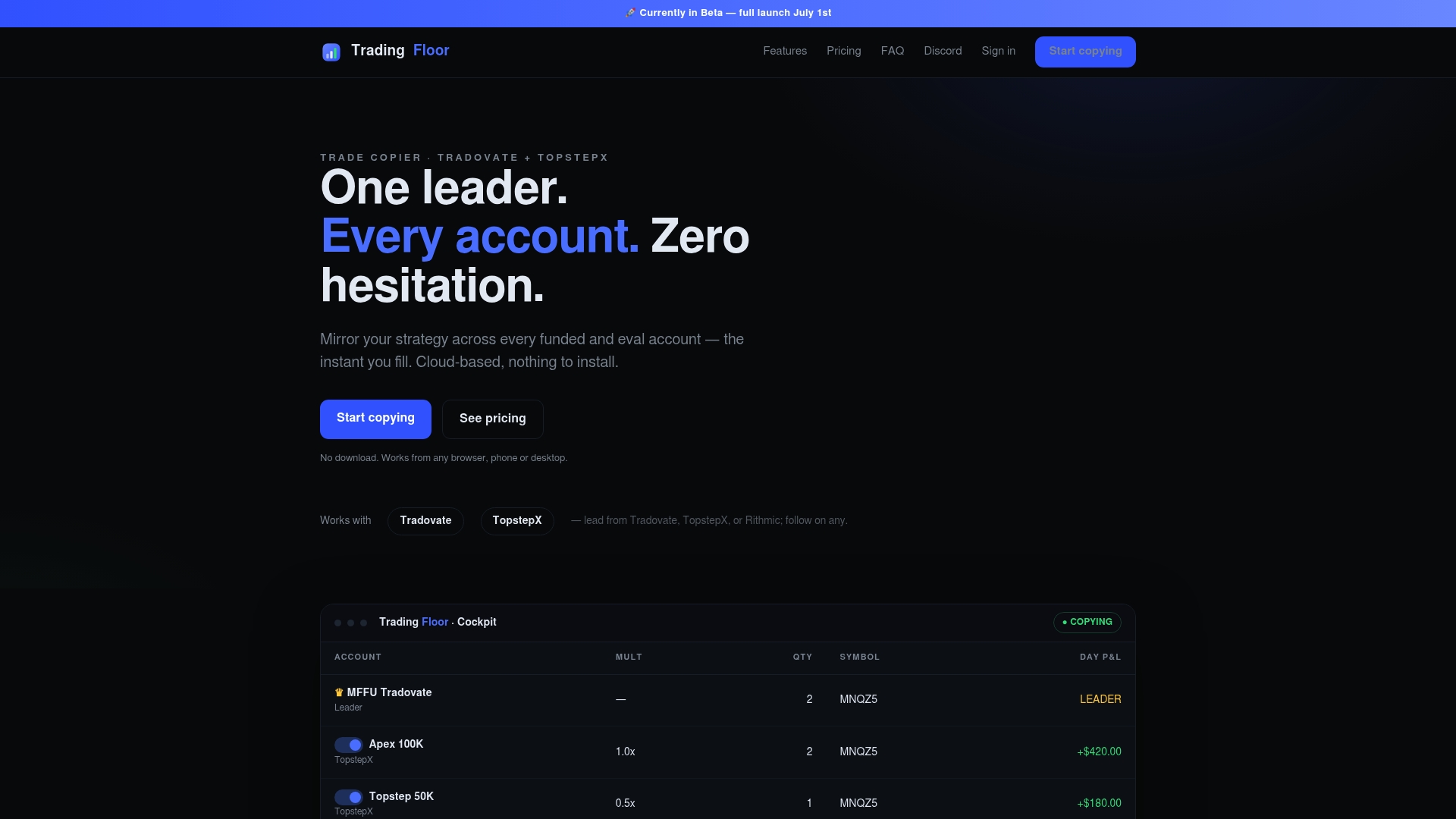
Because such tools are cloud-based with no installation needed, you can spin up a demo promotion and walk through your entire failover sequence—ownership check, protected mode, promotion, test trade, reconciliation—without using a funded account. That’s the rehearsal this guide keeps pointing back to, run inside the same tool you’ll use for the real thing. Start a free trial on the Take Profit Trader trade copier and validate your runbook before you ever need it under pressure.
Sources
- How to Copy Trade Funded Accounts Safely | Plutus Trade Base
- Master Account vs Slave Accounts: Prop Firm Risks Explained
Recommended
- Evaluation Account Management Best Practices for Prop Traders
- Trading Account Delegation Best Practices for Prop Traders
- Per-Account Risk Controls: The Role They Play for Multi-Broker Traders
- Evaluation Phase Trading Checklist for Prop Traders
Trading Floor mirrors every trade across your Tradovate, TopstepX & Rithmic accounts in real time, from $25/mo.
Start copying →