Link Trading for Prop Traders: Mirror Funded Accounts

Link trading is cloud-based trade copier software that mirrors a leader’s real-time net position across multiple funded and evaluation trading accounts, not a backlink swap and not the LINK cryptocurrency. The short answer: pick a stateful cloud copier with per-account risk controls, not a raw signal broadcaster. Before you touch a live account:
- Connect one funded leader and one follower account first.
- Run every trade in simulation mode for at least a day.
- Confirm receipts and journaling match before adding a third account.
A trade copier cuts out the manual execution errors that come from clicking across five broker tabs during a fast open, which is the whole point of doing this in the first place.
Key Takeaways
Link trading succeeds when a stateful cloud copier enforces per-account risk limits and multipliers instead of blindly broadcasting the same signal to every follower.
| Point | Details |
|---|---|
| Statefulness beats broadcasting | A copier that checks account state before every fill prevents oversized positions on funded accounts. |
| Test in simulation first | Connect one leader and one follower and run test trades before adding real capital. |
| Risk controls stay per-account | Max contracts, daily loss caps, and trailing drawdown pauses need to differ by account equity. |
| Verify firm rules before scaling | Most firms allow mirroring your own accounts but ban copying external signals. |
| Tradingfloor covers the core setup | Cloud-based mirroring with per-account multipliers, journaling, and Tradovate, TopstepX, and Rithmic support, plus a 30-day free trial. |
Table of Contents
- What a Real Link Trading Setup Needs to Include
- Who Actually Needs Link Trading?
- How Does Position Mirroring Actually Work?
- Which Brokers and Platforms Does Link Trading Support?
- How to Set Up Link Trading Step by Step
- What Risk Controls Should Every Linked Account Have?
- How Fast Does Link Trading Sync in Practice?
- What to Do When a Follower Account Falls Out of Sync
- What Does Link Trading Cost, and What’s Worth Testing in a Trial?
- How Should You Handle Credentials and Compliance?
- Final Checklist Before Going Live
- An Operator’s Take on Running Multiple Linked Accounts
- Where Tradingfloor Fits Into Your Link Trading Setup
- Sources
What a Real Link Trading Setup Needs to Include
Not every copier does the same job. A capable one holds state, meaning it knows each account’s current net position rather than just firing off a repeated signal.
- Stateful net-position mirroring with per-account contract multipliers, so a $50K account and a $150K account can hold different sizes on the same idea.
- Per-account risk controls: max contracts, daily loss caps, and a trailing drawdown pause that trips before the firm’s rule does.
- Broker and platform coverage, including Tradovate, TopstepX, and Rithmic, plus low-latency cloud execution, trade journaling, and push notifications when something breaks.
Pro Tip: Skip anything described as a simple webhook broadcaster. Look for simulation mode and a per-account override switch. If you can’t test a trade without risking real capital, that’s a red flag.
Who Actually Needs Link Trading?
If you’ve passed one evaluation and want to run the same edge across three more accounts, this is the tool built for that exact situation.
- Scaling a proven strategy from one funded account to several, multiplying payout potential without multiplying screen time.
- Running parallel evaluation challenges with identical risk rules so no account drifts from the plan under pressure.
- Bridging cross-broker setups, where one leader on Tradovate mirrors into followers on Rithmic.
Picture a scalper opening three funded accounts at once at the 9:30 bell, or a swing trader sizing one daily idea differently across five accounts based on each one’s equity.
How Does Position Mirroring Actually Work?
The architecture is simple in concept: a trading platform or alert source feeds a cloud-based copier, and that copier pushes sized orders out to each follower account’s broker endpoint. The engine in the middle is what separates real link trading from a glorified alert forwarder.
Net-position mirroring queries each follower’s current state before it sends anything, checks it against that account’s limits, and only then adjusts the position. Signal broadcasting does none of that. It just fires the same order everywhere and hopes every account can absorb it.
A stateful copier asks “what does this account currently hold, and what is it allowed to hold?” before every fill. A broadcaster asks nothing. It just shouts the same order at every account and lets the chips fall.
The parts that make this reliable in practice:
- Contract multipliers that scale position size per account automatically.
- Symbol mapping so a leader’s ES position translates correctly to a follower on a different feed.
- Slippage caps and reconciliation, so every fill gets logged and matched against what was intended.
A rough architecture diagram (leader platform → cloud engine → broker endpoints) makes this easier to visualize than any paragraph will.
Which Brokers and Platforms Does Link Trading Support?
Check compatibility before you connect anything. Tradovate, TopstepX, and Rithmic are the three platform names you’ll see most often supported, but coverage varies by copier and by firm.
- Confirm the connection type: Rithmic-based accounts behave differently from Tradovate API connections.
- Verify your firm actually permits this kind of automation in its rulebook.
- Test symbol mapping and margin requirements in sim mode before funding is at stake.
How to Set Up Link Trading Step by Step
You need a verified leader account, at least one follower (ideally a sim or small evaluation account first), and login credentials or API tokens ready before you start.
- Create a copy group and add your leader account.
- Add follower accounts one at a time, labeling each clearly.
- Set the contract multiplier for every follower relative to the leader.
- Configure slippage caps and drawdown rules per account.
- Map symbols across brokers if your leader and followers sit on different platforms.
- Enable simulation mode and send a test alert.
- Check the receipt log to confirm the mirrored trade matches what you expected.
Before you flip anything live, run through this short list:
- Test a market order end to end.
- Test how a stop or limit order behaves once it’s mirrored.
- Confirm journaling entries and push notifications actually fired.
Pro Tip: Label every account with the firm name, equity size, and an index number, something like “Apex $50K #1”. It sounds trivial until you’re staring at six identical-looking account rows during a fast market and need to know instantly which one just breached a limit.
What Risk Controls Should Every Linked Account Have?
Every follower account needs its own guardrails, independent of what the leader is doing. This isn’t optional if you’re running real funded capital across multiple accounts.
- Per-account max contracts and per-trade caps.
- Daily loss limits and trailing drawdown stops that trigger before the firm’s own rule does.
- Session caps that stop new entries after a set time or loss threshold.
Stagger your account groupings by equity size rather than mirroring identical position sizes everywhere. A $25K evaluation account and a $150K funded account should never hold the same contract count on the same signal. Turn on auto-pause for any account nearing its drawdown limit, and watch for the usual warning signs: stops that fail to sync, cancels that don’t go through, fills that don’t match across accounts.
Pro Tip: Watch two numbers at once: your total net exposure across every account, and how close each individual account sits to its drawdown ceiling. The first tells you your overall risk. The second tells you which account is about to get you disqualified.
How Fast Does Link Trading Sync in Practice?
Cloud-based copiers typically route broker-side execution in well under a second, often in the low hundreds of milliseconds, compared to the several seconds it takes to manually click through multiple platforms.
- Send a timestamped test order from the leader.
- Record the exact fill time on each follower account.
- Compare round-trip timing from alert source to final execution across all accounts.
Latency matters most at the open and during high-volatility spikes, which is exactly when you should have per-account overrides ready to go. A stateless broadcaster might shave off a few milliseconds, but a stateful copier’s extra state checks are the reason your account doesn’t get oversized on a bad tick.
What to Do When a Follower Account Falls Out of Sync
The usual culprits are a disconnected follower, a wrong contract multiplier, a missed stop or limit sync, or a firm blocking the automation outright.
- Pause the whole copy group first, don’t try to fix it live.
- Test a single account in isolation to confirm the fill behavior.
- Reapply multipliers and recheck symbol mapping before resuming.
- If the mismatch clears after one test trade, resume copying.
- If fills stay mismatched or cancels keep failing, stop and pull the trade journal.
- If you suspect a gap in the journal itself, escalate before placing another trade.
What Does Link Trading Cost, and What’s Worth Testing in a Trial?
Most copiers price as a flat monthly subscription rather than charging per connected account, and a 30-day free trial is common across the category, giving you real time to stress-test the system before committing.
- During any trial, connect at least two accounts and confirm multipliers apply correctly.
- Push the system into simulation mode and deliberately trigger a failure to see how it recovers.
- Pull a journaling export and confirm it has everything a firm audit would ask for.
If a trial doesn’t include journaling or notifications, walk away. Those two features are exactly what you’ll need if a prop firm ever questions your execution history.
How Should You Handle Credentials and Compliance?
Credential handling separates a serious copier from a risky one. Look for encrypted storage, least-privilege API keys instead of shared logins, audit logs, and two-factor access on the dashboard itself.
- Never hand over your actual broker password if an API key or token option exists.
- Confirm your prop firm’s specific stance on internal copy trading before enabling anything live, since most major firms permit mirroring your own accounts but prohibit copying someone else’s signals.
- Keep exportable receipts on hand; Tradingfloor’s sourced breakdown of prop firm copy trading rules is a good place to check firm-by-firm before you scale.
Final Checklist Before Going Live
Run through this in under five minutes before flipping the switch from simulation to real capital:
- One test order and one test stop, both confirmed filled correctly.
- Multipliers verified per account, journal receipts confirmed, and drawdown settings double-checked.
- At least one live micro contract test completed, with alert timestamps matching follower fills.
Only go live once every box above is checked, not before.
An Operator’s Take on Running Multiple Linked Accounts
Running six accounts through one copier changes your morning routine. You stop watching charts constantly and start watching a dashboard instead, checking fills, drawdown proximity, and connection status before you even think about the next entry.
The habit that actually matters is a weekly reconciliation pass, not a daily one. Daily checks catch the obvious stuff. A weekly pass catches the slow drift, a multiplier that got reset, an account that’s been running slightly out of sync for three days without tripping any alert. When a follower does drop offline mid-session, pause the group, don’t chase it. Use conservative multipliers during anything resembling a news spike; that’s when a small sizing mistake turns into a real drawdown problem.
Where Tradingfloor Fits Into Your Link Trading Setup
Tradingfloor is built specifically around the workflow this article just walked through: cloud-based real-time position mirroring with per-account multipliers, drawdown stops, trade journaling, and push notifications, all without installing anything on a local machine or VPS.
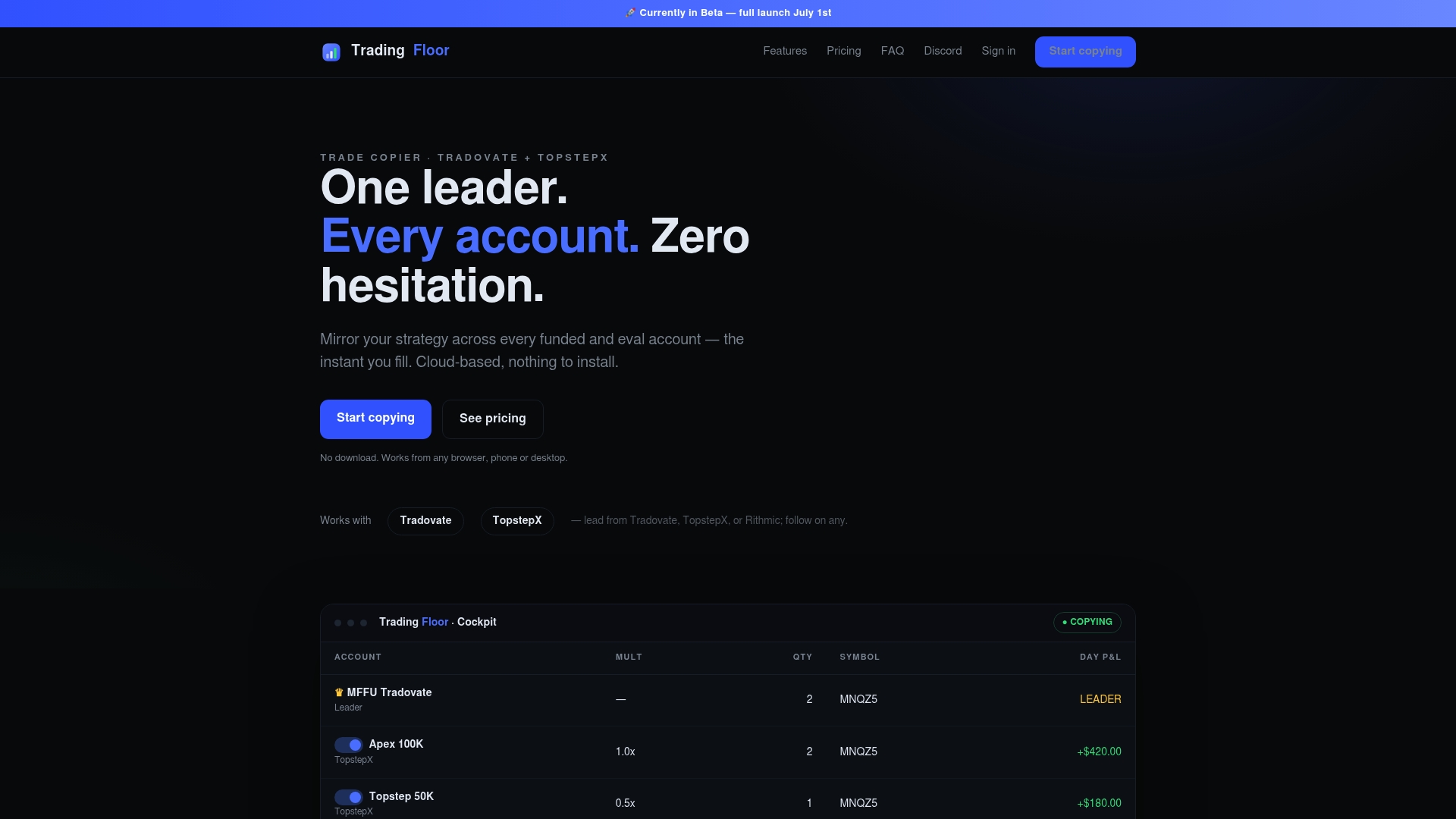
It connects with Tradovate, TopstepX, and Rithmic, and supports multiple prop-firm account types through dedicated integration pages, including the Take Profit Trader copier, the TradeDay copier, the Earn2Trade copier, and the Tradeify copier. Each one gives you a concrete look at setup steps for that specific firm before you connect anything real.
Start with the 30-day free trial, connect one leader and one follower account, run everything in simulation, and confirm the journaling and notifications hold up before you add a second or third account. If your firm’s rules are unclear on internal copying, check Tradingfloor’s sourced list of prop firm copy trading policies first so you scale on solid ground instead of guessing.
Sources
- How to Manage Multiple Prop Firm Accounts | 2026 Guide
Recommended
- How to Mirror Trades Across Prop Accounts Precisely — Trading Floor
- Trades Copied Right: Real-Time Mirroring for Prop Traders — Trading Floor
- Prop Trading Leader Accounts: What Funded Traders Need to Know — Trading Floor
- Best prop.tradovate.com Alternatives for Multi-Account Prop Traders — Trading Floor
Trading Floor mirrors every trade across your Tradovate, TopstepX & Rithmic accounts in real time, from $25/mo.
Start copying →