6 Step Multi Account Prop Firm Compliance for Automated Copying

Prop firm rule compliance comes down to one habit: computing each account’s live rule set, floor, daily loss limit, and max contracts, before every single order goes out. Traders who copy trades across multiple funded and evaluation accounts break rules not because they ignore them, but because they check them once and assume they hold. They don’t. Start with Topstep’s help documentation and CME Group’s risk education as your baseline, then build a process around pre-trade simulation, auto-flatten triggers, and real-time alerts.
TL;DR:
- Traders must consistently verify each account’s specific rule set, including maximum loss, daily limits, and contract caps, before executing any trade.
- Automating rule synchronization, pre-trade simulations, and real-time alerts help ensure compliance across multiple funded or evaluation accounts.
- Position sizing should prioritize stop-loss risk in dollars first, then check that against account-specific contract limits and stage-based rules.
- Regularly testing automation scenarios for payout, partial fills, and latency spikes highlights potential breach points before they occur in live trading.
- Using a platform that manages multi-account synchronization and risk controls in real time reduces operational errors and enhances compliance discipline.
Table of Contents
- What Rules Do You Actually Have to Track per Account?
- How Do You Keep Every Account Compliant When Copying Trades?
- How Should You Size Positions Across Different Firm Caps?
- What Automation and Testing Catch Breaches Before They Happen?
- A Session-by-Session Compliance Checklist
- Why Operational Discipline Beats Reactive Hedging
- How Tradingfloor Handles the Multi-Account Compliance Problem
- Sources
- FAQ
What Rules Do You Actually Have to Track per Account?
Every funded or evaluation account carries its own rule set, and the rules interact differently depending on account stage and firm. Before you copy a single trade across accounts, you need to know exactly what you’re checking.
- Maximum loss / floor. Know whether the firm calculates this at end-of-day or intraday, and calculate your remaining drawdown from the floor itself, not the account’s headline balance. Topstep’s Maximum Loss Limit references a floor that can trigger liquidation mid-session even though the limit is set at end-of-day.
- Daily loss limit. Understand whether hitting it forces a break for the day or counts as a violation, and how personal DLL settings (PDLL) change that outcome.
- Max contracts and product permissions. Each account has its own ceiling, and it rarely matches across accounts at different stages.
- Consistency and profit targets. These shift as an account moves through evaluation stages, and a rule that applied last week may not apply today.
- Single-profile policy and trading day boundaries. Trading the wrong account, or trading past a session cutoff, can trigger closure on its own, independent of your P&L.
Miss any one of these on a single account and a copied trade that’s perfectly fine on Account A becomes an instant violation on Account B.
How Do You Keep Every Account Compliant When Copying Trades?
A repeatable process beats a mental checklist every time, especially once you’re running four or five accounts at once. Here’s the sequence that actually holds up under pressure:
- Sync rules at session start, and again after any payout, stage change, or balance update. Rule sets are not static. Topstep’s live-funded account parameters shift as accounts scale, and a rule you read yesterday may be wrong today.
- Simulate the order against every destination account’s parameters before it fires. If an order would breach the floor, the daily stop, or the max contract count on any single account, scale it down or reject it there. Never fire the same size everywhere by default.
- Apply per-account transforms. Contract multiplier, stop distance, position caps, and flatten-on-breach logic all need to run independently for each account, not off one master setting.
- Confirm fills and reconcile positions automatically. A partial fill on one account and a full fill on another leaves you with mismatched exposure unless something catches it immediately.
- Journal every event. Entry, stop, size, and the rule check that approved it. This is what makes an account defensible if a firm ever asks questions.
- Set alerts, and enforce fail-safe flatten or lock behavior the moment a trigger fires, rather than waiting for you to notice.
Pro Tip: Don’t rely on your own memory to catch when an account graduates from evaluation to funded. That transition often changes the daily loss limit and max contract count the same day, and a copier that hasn’t resynced will happily send the old size through.
How Should You Size Positions Across Different Firm Caps?
Size from your stop first, and check the firm’s cap second. That order matters more than most traders realize.
Start with dollar risk: multiply your stop distance in ticks by the contract’s tick value to get dollar risk per contract. CME Group’s risk education frames this as the professional default, deriving contract count from the loss scenario you’re willing to accept, not from what the account can technically hold.
- Divide your acceptable dollar risk (many traders use a fixed percentage of account equity as a cap) by the per-contract dollar risk to get your contract count.
- Then check that number against the firm’s maximum contracts for that specific account and stage.
- Multipliers change the math across accounts. Two accounts holding the “same” 3-contract position can carry very different effective exposure if one account’s multiplier differs from another.
- Margin requirements and intraday-versus-overnight limits can shrink your allowable size even when the stop-based math and the firm’s contract cap both say you’re fine.
A CME framework worth knowing by name is the 2% Rule, which caps dollar risk per trade at a fixed share of equity and works backward into contract count. It’s a starting point, not a hard requirement every firm enforces, but it gives you a defensible number to check against the firm’s own contract ceiling.
What Automation and Testing Catch Breaches Before They Happen?
Automation only helps if it treats a triggered limit as an enforced consequence, not a suggestion to adjust. Topstep’s Daily Loss Limit documentation shows PDLL configurations that flatten and lock an account for the session once a threshold hits, and your automation should mirror that behavior exactly, not offer you a chance to widen the limit mid-session.
- Run scenario tests that replicate payouts, forced liquidations, partial fills, and latency spikes, not just clean-market conditions.
- Test on practice or staging accounts first, using simulated fills before any live capital moves.
- Build in slippage caps and verified latency monitoring so a delayed fill doesn’t silently oversize a position.
- Reconcile every system trade against the actual broker fill and keep an immutable audit log of the comparison.
Pro Tip: Systems that only check thresholds miss the edge cases that actually cause breaches. A scenario test that simulates a payout landing mid-session, or a partial fill during a volatility spike, will surface problems a clean backtest never shows you.
A Session-by-Session Compliance Checklist
Run this same sequence every trading day, regardless of how many accounts you’re managing:
- Session start. Sync each account’s current rules and verify balances against the firm’s floor, not your own running total.
- Before every trade. Simulate the order per account, size it from your stop, and confirm product permissions and contract caps for that specific account and stage.
- On execution. Confirm fills, reconcile any partials immediately, and journal the trade with its size, stop, and the rule check that cleared it.
- On any trigger. Flatten and lock automatically, record the event, and escalate to yourself for review before resuming.
- Post-session. Audit the day’s journal entries, update account mappings for any changes, and resync rules if a payout or stage change happened.
Skip the post-session audit often enough and you’ll eventually miss a stage transition that quietly changed your max contract count overnight.
Why Operational Discipline Beats Reactive Hedging

Most breaches I’ve seen traders describe aren’t from bad trades. They’re from trusting the account’s headline balance instead of calculating the actual floor before the next order fired. That gap between the number on the screen and the number the firm actually enforces is where accounts get liquidated mid-session on otherwise solid setups.
Audit-proof, entry-only copying and verified latency logs do more for your standing with a firm than any explanation after the fact. Lock your per-session limits at the start of the day rather than adjusting them on the fly. Rule changes belong in your resync process, not in a live override you make because a trade “feels right.”
— KennyTrades
How Tradingfloor Handles the Multi-Account Compliance Problem
Manually rechecking rules across four or five accounts before every order isn’t a workflow, it’s a liability. The platform mirrors a leader’s net position across multiple funded and evaluation accounts in real time, while managing each account’s contract multiplier, position limits, and flatten-on-breach logic independently.
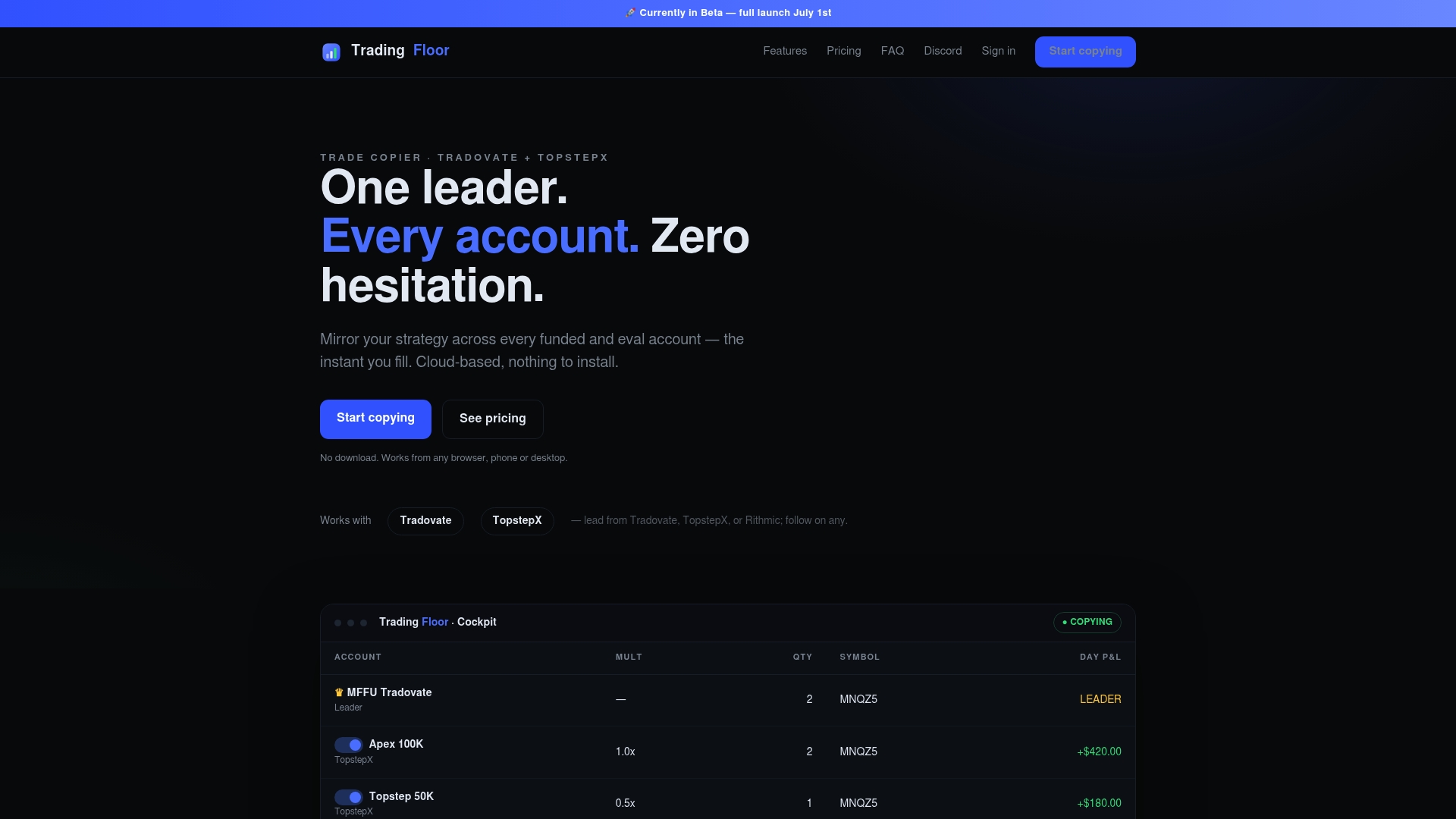
Every trade carries verified latency published live, and every position reconciles automatically against your broker fills across platforms like Tradovate and TopstepX, with an audit log behind it. Per-account risk controls and real-time notifications catch a breach before it becomes a liquidation, not after. Plans run flat rate rather than per account: Starter at $25 per month or $250 per year, and Pro at $50 per month or $500 per year. If you’re checking whether your specific firm even permits copying before you commit to a workflow, see which prop firms allow copy trading first. Start a trial and see how your own accounts sync on the pricing page.
Sources
- What is the Maximum Loss Limit? — Topstep Help Center
- Master the trade: Managing futures risk — CME Group
FAQ
What Is the Difference Between a Daily Loss Limit and a Max Loss Limit?
A daily loss limit caps how much you can lose in a single session before trading is paused or the account is closed, while the max loss limit (or trailing drawdown) tracks your floor over the account’s full life. Topstep’s documentation shows the max loss limit is calculated at end-of-day but can still trigger liquidation intraday if you fall below the floor.
How Do I Calculate Remaining Drawdown Room Correctly?
Calculate it from the firm’s stated floor, not your account’s current or starting balance. A drawdown calculator built around each firm’s specific floor logic removes the guesswork of doing this math by hand across several accounts.
Can I Use the Same Position Size Across All My Prop Accounts?
No. Contract multipliers, max contract limits, and stage-based rules vary by account, so the same nominal position can be compliant on one account and a violation on another. Size from your stop-loss dollar risk first, per CME Group’s guidance, then apply each account’s own transform.
What Happens if I Breach a Rule While Copying Trades?
Consequences depend on the rule and the firm, ranging from a forced flatten and session lock to full account closure for repeated or severe breaches. Automation that treats a trigger as an enforced stop, rather than a chance to adjust limits, is the safest design according to Topstep’s own daily loss limit rules.
Does Tradingfloor Cost the Same for Every Account I Add?
No, Tradingfloor charges a flat subscription rather than a per-account fee. The Starter plan runs $25 per month or $250 per year, and Pro runs $50 per month or $500 per year, both covering multi-account copying under one price.
Recommended
- How to Automate Position Copying in Prop Trading
- Avoid Consistency Rule Violations When Copying Trades
- Common Automated Investing Mistakes for Multi-Account Copiers
- Prop Firm Trade Copier — run every funded account as one floor
Trading Floor mirrors every trade across your Tradovate, TopstepX & Rithmic accounts in real time, from $25/mo.
Start copying →