Multi-Account Automation Investing: A 2026 Trader's Guide

Multi-account automation investing refers to the automated, simultaneous management of multiple investment accounts from a single centralized interface. Traders managing two, five, or twenty accounts face a hard reality: manual execution across accounts multiplies both effort and error risk at every trade. The role of multi-account automation investing is to replace that manual grind with parallel, rule-driven execution that delivers consistent prices, fair allocation, and full audit trails across every account at once. Platforms like Tradingfloor have made this approach accessible to prop traders managing funded and evaluation accounts across brokers like Tradovate and TopstepX, without requiring complex installations or manual position copying.
What is the role of multi-account automation investing?
Multi-account automation investing is defined by one core mechanism: a master account places a single bulk order that is instantly allocated across multiple sub-accounts using predefined rules. That single action replaces what would otherwise be a sequence of manual trades, each with its own timing, price, and error risk.
The industry uses two primary frameworks to govern this process. Portfolio/Model Account Management (PAM/MAM) systems distribute trades proportionally across sub-accounts based on allocation profiles. Unified Managed Account (UMA) technology goes further, coordinating tax management, diversification, rebalancing, and reporting under a single account umbrella. Both frameworks exist to solve the same problem: how do you treat every account fairly when you are executing at scale?

The answer lies in allocation rules. Pro-rata allocation distributes shares in proportion to each account’s size. Fixed-quantity allocation assigns the same number of units to every account. Percent allocation assigns a fixed percentage of each account’s capital. Choosing the right rule depends on your trading strategy and the mandates governing each account.
Pro Tip: Set your allocation profile before you place a single trade. Changing allocation rules mid-campaign creates inconsistent position sizes and complicates your audit trail.
How does multi-account automation work technically?
The technical architecture behind multi-account automation centers on parallel processing. When the master account sends an order, the system fans it out to all sub-accounts simultaneously rather than sequentially. Automated trade allocation reduces execution time from 30–45 minutes to mere seconds by replacing manual spreadsheet workflows with parallel-processing systems. That speed difference is not cosmetic. Sequential execution means early sub-accounts get better prices than later ones, creating unfair outcomes and compliance exposure.
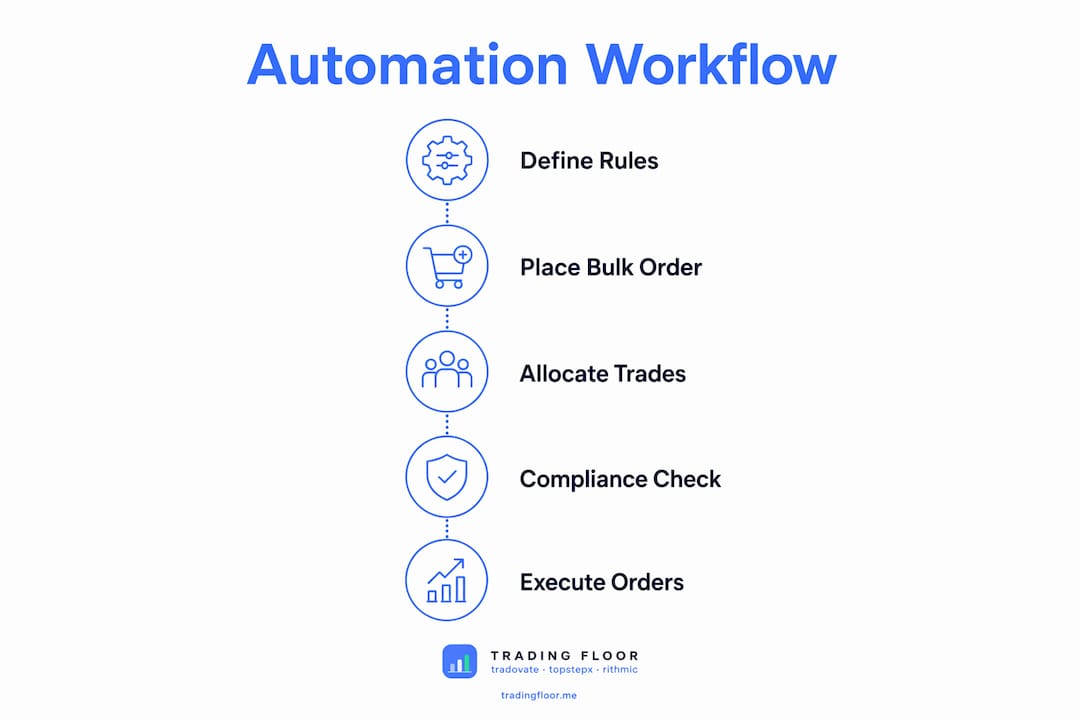
The workflow typically follows these steps:
- The master account generates an order with a target allocation profile.
- The automation system validates the order against pre-trade compliance rules for every sub-account simultaneously.
- Approved orders fan out to all sub-accounts in parallel, securing uniform execution prices.
- The Order Management System (OMS) logs every allocation decision, timestamp, and fill price for audit purposes.
- Post-trade reconciliation confirms that each sub-account received its correct share and flags any exceptions automatically.
Embedding trade allocation logic directly into the OMS with parallel compliance evaluation accelerates workflows from tens of minutes to seconds and removes manual risk from the process. That integration is what separates a true automation architecture from a basic copy-trading setup.
What are the main benefits of automating multiple investment accounts?
The efficiency gains from multi-account automation are measurable and significant. UMA technology saves financial advisors up to 60–90 minutes per day, equating to 300 hours annually and $45,000 in recaptured operational capacity. For a solo trader or a small prop trading team, that time translates directly into more trades analyzed, more risk reviewed, and fewer hours spent on administrative work.
Beyond time savings, automation delivers four operational advantages that manual processes cannot match:
- Error reduction. Automated validation catches order mismatches, position limit breaches, and compliance violations before execution, not after.
- Consistent pricing. Parallel execution means every sub-account gets the same fill price, eliminating the fairness problems that plague sequential manual entry.
- Tax and restriction handling. Automation systems can apply account-level tax lot sensitivities and trading restrictions simultaneously, without requiring a separate manual review for each account.
- Unified reporting. A single consolidated view across all accounts replaces the patchwork of individual account statements that traders otherwise have to reconcile by hand.
Scalability is the benefit that compounds over time. A trader who manually manages five accounts hits a ceiling fast. Automation removes that ceiling. You can grow your account book without adding proportional headcount or accepting proportional increases in error risk. That is the core value proposition of efficient investment portfolio management at scale.
What are the risks in multi-account automation, and how do you mitigate them?
The chief risk in multi-account automation is error multiplication. A single mistake in the master account replicates instantly across every sub-account. One master account error can multiply financial damage across all sub-accounts, making automated error-checking and pre-execution compliance evaluation non-negotiable. This is the feature that separates professional-grade automation from basic copy tools.
Common risks and their mitigations include:
- Order entry errors. A wrong quantity or wrong direction in the master account hits every sub-account. Pre-trade validation rules that check order parameters against account mandates catch these before execution.
- Trade slippage from large aggregate orders. When all sub-accounts trade the same instrument simultaneously, the combined order size can move the market. Splitting large orders or using smart order routing reduces this impact.
- Compliance drift. Account restrictions change over time. Automation systems need regular audits to confirm that restriction sets and allocation rules still match current mandates.
- Platform dependency risk. A system outage during a live trade can leave accounts in mismatched states. Real-time status monitoring and manual override protocols are the backstop.
Pro Tip: Build a human-in-the-loop checkpoint for any order above a defined size threshold. Automation handles speed. Human review handles judgment calls that no rule set fully anticipates.
Simpler model frameworks may outperform complex UMA structures for traders with straightforward portfolio transitions and limited tax coordination needs. Deploy UMA infrastructure only when the complexity genuinely justifies the added platform fees and operational overhead. Matching your infrastructure to your actual complexity level is itself a risk management decision.
How do you implement multi-account automation in your trading workflow?
Implementation follows a clear sequence. Skipping steps creates gaps that show up as errors or compliance failures later.
- Audit your current workflow. Map every manual step in your existing trade process. Identify where errors occur most often and where time is lost. These are your automation targets.
- Choose a platform that supports parallel processing and compliance integration. Look for systems that embed compliance checks directly into the order flow, not as a separate post-trade step. Tradingfloor, for example, mirrors the leader’s net position across funded and evaluation accounts in real time while maintaining individual risk controls per account.
- Define your allocation rules. Match your allocation profile (pro-rata, fixed quantity, or percent) to your strategy and account mandates before going live.
- Configure risk management parameters. Set drawdown limits, position size caps, and restriction sets at the account level. These parameters should be non-overrideable by default.
- Connect your broker accounts. Multi-broker aggregation tools allow traders to connect multiple providers, enabling consolidated portfolio views across accounts for better oversight.
- Run a controlled test. Execute a small, low-risk trade across all accounts before going live at full scale. Verify that allocation, pricing, and logging all work as expected.
- Monitor, log, and adjust. Review audit logs after every session. Track allocation accuracy, execution prices, and any exceptions. Adjust rules based on what the data shows.
The cross-account trade management process works best when you treat it as a living system. Rules that fit your workflow today may need adjustment as your account book grows or your strategy evolves.
What role do AI agents play in multi-account automation investing?
AI agents represent the next layer of capability in automated investment strategies. Rather than executing a single master order across all accounts, AI agents manage individual accounts independently, each following its own risk rules and strategy mandate. AI agents managing client accounts follow custom risk rules and strategies independently, providing continuous, fatigue-free monitoring, enforcing position and risk limits, and supporting large-scale portfolio management without additional staff.
The practical advantages for traders managing multiple accounts are significant:
- 24/7 monitoring. AI agents do not sleep, take breaks, or lose focus during volatile sessions. They react to market events at machine speed.
- Per-account mandate enforcement. Each agent enforces its own account-level rules without overrides, eliminating the risk of a single decision affecting accounts with different mandates.
- Scalability without headcount. AI agents enable firms to manage significantly larger account books by enforcing strict, non-overrideable risk mandates independently per account, extending capacity without proportional staff increases.
- Full logging and transparency. Every agent action is logged with a timestamp and rationale, giving traders a complete audit trail for compliance and performance review.
AI agents do not replace human judgment on strategy. They execute that strategy with a consistency and speed that human traders cannot sustain across multiple accounts simultaneously. The combination of human strategy and AI execution is what makes large-scale multi-account management viable for individual traders and small teams.
Key Takeaways
Multi-account automation investing delivers its full value only when parallel execution, pre-trade compliance validation, and account-level risk controls operate together as a single integrated system.
| Point | Details |
|---|---|
| Parallel execution is the foundation | Simultaneous order distribution across all sub-accounts secures uniform prices and eliminates sequence risk. |
| Error multiplication is the primary risk | One master account mistake replicates instantly; pre-trade validation and human checkpoints are non-negotiable safeguards. |
| UMA infrastructure requires justification | Deploy UMA structures only when tax coordination and complexity genuinely justify the added fees and overhead. |
| AI agents extend capacity without extra staff | Per-account AI mandate enforcement allows traders to scale their account book without proportional increases in manual oversight. |
| Automation requires ongoing calibration | Allocation rules, risk parameters, and restriction sets need regular audits as your strategy and account book evolve. |
The infrastructure decision most traders get wrong
Most traders focus on the automation tool and ignore the infrastructure decision underneath it. That is the wrong order of operations. The tool executes your rules. The rules reflect your infrastructure. If your infrastructure is mismatched to your actual complexity, no tool fixes that.
I have watched traders deploy full UMA setups for account books that had no meaningful tax coordination requirements. The result was higher platform fees, more operational friction, and no measurable benefit over a simpler PAM/MAM framework. The investor account automation best practices conversation should start with an honest assessment of what you actually need, not with what sounds most sophisticated.
The AI agent question is where I think the field is genuinely ahead of most traders’ awareness. The ability to assign independent, non-overrideable risk mandates to individual accounts and have an agent enforce them around the clock is a qualitative shift in what a small team can manage. But it only works if your underlying allocation and compliance architecture is already sound. AI on top of a broken workflow is just faster mistakes.
My honest recommendation: start with the simplest framework that handles your current account count and complexity. Build the audit habit from day one. Then scale the technology as your account book grows and your compliance requirements increase. The traders who get this right treat automation as infrastructure, not as a shortcut.
— KennyTrades
Tradingfloor: centralized control across every account
Prop traders managing multiple funded and evaluation accounts need more than a copy-trading signal. They need real-time position mirroring with individual risk controls per account, accessible from any device without software installs.
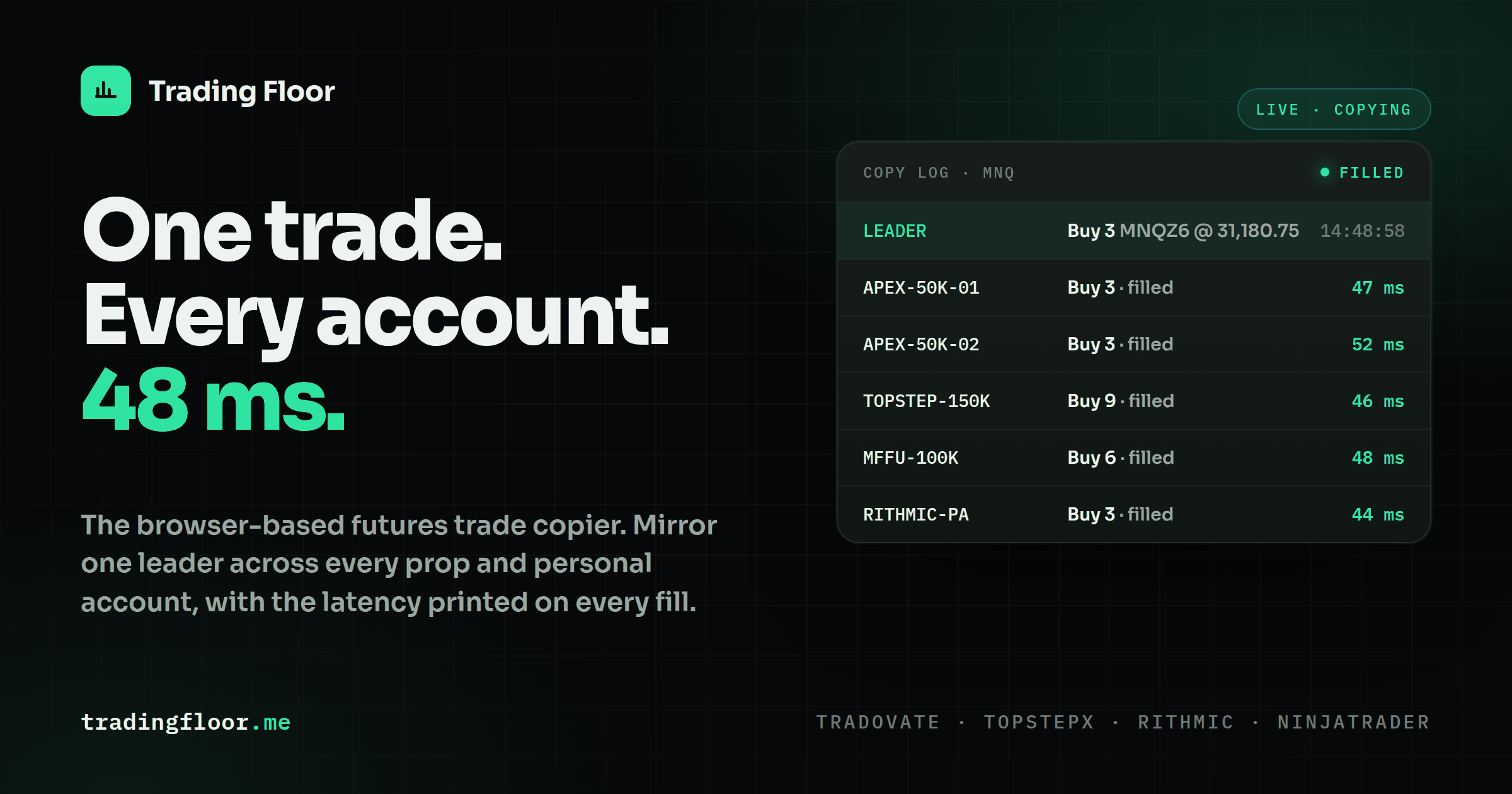
Tradingfloor mirrors the leader’s net position across all connected accounts simultaneously, covering brokers including Tradovate and TopstepX. Trade limits, real-time notifications, and per-account risk controls are built into the platform. Traders can review pricing and plan options to find the setup that fits their account count and strategy. For current platform stability, the system status page provides live updates. Tradingfloor is built for traders who need execution consistency across every account, every trade.
FAQ
What is multi-account automation investing?
Multi-account automation investing is the automated, simultaneous management of multiple investment accounts from a single interface. A master account places one bulk order that is instantly allocated across all sub-accounts using predefined rules, ensuring uniform execution prices and consistent portfolio oversight.
How does automated trade allocation reduce errors?
Automated trade allocation applies pre-trade compliance validation to every sub-account simultaneously before any order executes. This catches order mismatches, position limit breaches, and restriction violations before they reach the market, preventing the error multiplication that manual processes create.
What is the difference between PAM/MAM and UMA structures?
PAM/MAM systems distribute trades proportionally across sub-accounts based on allocation profiles. UMA structures go further by coordinating tax management, diversification, rebalancing, and reporting under a single account umbrella, but add platform fees and operational complexity that only justify deployment when tax coordination requirements are significant.
How do AI agents improve multi-account management?
AI agents manage individual accounts independently, each enforcing its own risk rules and strategy mandate continuously without fatigue. They provide 24/7 monitoring, machine-speed reaction to market events, and full audit logs, allowing traders to scale their account books without proportional increases in manual oversight.
What risk controls should every multi-account automation setup include?
Every setup needs pre-trade validation rules, account-level drawdown limits, position size caps, and a human-in-the-loop checkpoint for large orders. Regular audits of allocation rules and restriction sets are also required to keep the system aligned with current account mandates.
Recommended
- Automate Trades During Account Evaluation: A Prop Trader’s Guide — Trading Floor
- Multi-Account Trade Execution Explained for Prop Traders — Trading Floor
- Multi-Platform Trading Best Practices for Prop Traders — Trading Floor
- Cross-Account Trade Management: A 2026 Trader’s Guide — Trading Floor
Trading Floor mirrors every trade across your Tradovate, TopstepX & Rithmic accounts in real time, from $25/mo.
Start copying →