3 Operational Controls Prop Traders Use to Scale Trading Across Brokers

Scaling one strategy across multiple brokers works, but only if three things are in place first: idempotent order routing so signals never duplicate, an explicit allocation rule for sizing each account, and per-account risk and margin controls tied to daily reconciliation. Some platforms build exactly this stack, mirroring a leader’s net position in real time across funded and evaluation accounts while keeping each account’s risk limits independent. Skip any of the three, and scaling turns into a liability rather than an edge.
TL;DR:
- Scaling requires reliable, idempotent order routing, explicit account allocation rules, and per-account risk controls tied to daily reconciliation; skipping any piece turns scaling into a liability.
- Preliminary testing of each broker connection is essential, including staged paper runs to verify fills and delay differences, before integrating multiple accounts into a live system.
- Proper risk management separates broker margin limits from total portfolio risk, demanding allocation models with hard caps and daily reconciliation to prevent dangerous concentration.
- Address settlement timing differences by pulling actual settled balances before sizing trades, as inconsistent clearing times can distort account capacity and lead to overleveraging.
- Trading software like Trading Floor offers real-time position mirroring, independent risk controls, and audit logs, which are critical for reliable multi-broker scaling and regulatory compliance.
Table of Contents
- What Do You Need Before You Scale Trading Across Brokers?
- How Do You Manage Risk When Margin Rules Differ by Broker?
- How Does One Trading Signal Become Multiple Broker Orders?
- What Regulatory Rules Apply to Scaling Across Brokers?
- What Are the Most Common Failure Points When Scaling?
- Pre-Live Checklist Before You Scale
- How Trading Floor Reduces Synchronization Errors Across Accounts
- Why Do Settlement Times Differ Between Brokers?
- How Much Do Fees and Slippage Really Cost When Scaling?
- Author Perspective: Realistic Limits on Scaling Alone
- Get Started With Trading Floor
- Sources
- FAQ
What Do You Need Before You Scale Trading Across Brokers?
Before you replicate a single strategy across five, ten, or thirty accounts, you need the wiring in place, not just the strategy logic. Most traders who try to scale trading across brokers manually, with a spreadsheet and a few browser tabs, hit a wall around account four or five. The bottleneck is never the strategy. It’s the plumbing.
Start with the signal itself. Every trade intent your strategy generates needs to carry more than a ticker and a direction. It needs a unique identifier, a strategy version tag, risk caps, and metadata describing the intended allocation method before it ever reaches a broker adapter. This is what lets downstream systems tell the difference between a legitimate re-entry and a duplicate webhook firing twice.
Your distribution software has to handle a specific list of jobs:
- Per-account position sizing based on each account’s equity or a fixed allocation rule
- Symbol mapping, since futures contracts and tickers vary by broker and by expiration cycle
- Broker-specific adapters that translate one order type into whatever that broker’s API actually accepts
- Full audit trails logging every signal, translation, and fill for later reconciliation
Connectivity matters just as much as logic. Most modern broker APIs, including those behind Tradovate and TopstepX, use OAuth-based authentication and enforce rate limits that can silently throttle your orders during high-volume periods. Build in monitoring that flags a stalled connection or an authentication token nearing expiration before it causes a missed fill, not after.
Before any live capital moves, run staged paper tests against every broker in your stack individually. Fills, slippage, and even order acknowledgment timing can differ meaningfully between a demo environment and live execution, and staged rollouts catch those gaps early. A strategy that fills cleanly on one platform can slip badly on another purely because of how that broker’s matching engine handles your order type. Test each broker connection separately before you ever combine them into one automated flow.
How Do You Manage Risk When Margin Rules Differ by Broker?
Margin is a broker-level constraint. Risk is a portfolio-level property. Confusing the two is the single most common mistake traders make when they scale trading across brokers, and it’s an easy mistake to make because both concepts feel like they’re describing “how much I can lose.”
They aren’t the same thing. A broker sets margin requirements based on its own rules, its clearing relationships, and the instrument in question. Your actual risk exposure is the sum of every open position across every account, regardless of which broker holds it. You can be well within margin limits on each individual account while carrying dangerously concentrated aggregate exposure across your whole operation. That gap is exactly where undisciplined scaling gets expensive.
Choosing an allocation model is where this gets operational:
- Equal dollar allocation sends the same notional amount to every account, simplest to implement but ignoring differences in account size.
- Percentage of equity scales position size to each account’s current balance, better for accounts of different sizes but requiring fresh equity snapshots before every trade.
- Equal risk allocation sizes positions so each account risks the same dollar amount relative to its stop distance, the closest match to true risk parity.
- Fixed quantity sends an identical contract count everywhere, useful for prop firm accounts with similar sizing rules but risky if account sizes vary widely.
- Account-priority allocation fills higher-priority accounts first when liquidity or margin is constrained, common when some accounts matter more than others.
Whichever model you pick, back it with hard per-account limits: maximum exposure caps, contract multipliers that scale position size correctly per instrument, slippage caps that reject fills too far from expected price, and auto-flatten rules that close positions automatically when an account nears a drawdown threshold or a firm-imposed limit.
Pro Tip: Run a daily reconciliation pass, not a weekly one. Compare each account’s reported positions, cash balance, and open orders against what your system expects. A one-day lag between an actual fill and your recorded fill is how small discrepancies turn into a blown account by Friday.
How Does One Trading Signal Become Multiple Broker Orders?
Turning a single strategy decision into coordinated action across several brokers is the actual engineering problem behind scaling. Get this wrong and you’ve automated your losses, not your gains.
The process starts with a normalized signal, not a raw order. That signal should include a unique idempotency key, the intended risk or notional amount per account, and stop and target parameters, stored as a receipt you can later reconcile against actual fills. Because each broker account has to be treated independently for adapters, mapping, and rate limits, scaling across brokers is meaningfully harder than scaling across multiple accounts within a single broker.
From there, routing logic takes over:
- Translate the normalized signal into a broker-specific payload, converting symbols and contract specifications for each destination
- Apply the account’s allocation rule to determine size before the order leaves your system
- Track order lifecycle states (submitted, partially filled, filled, rejected) separately for every account
- Trigger automated remediation the moment a partial fill or rejection appears, rather than waiting for a human to notice
Failures will happen. An API will time out mid-session, a broker will reject an order for a margin reason you didn’t anticipate, or a fill will come back partial. Your system needs retry and backoff rules defined in advance: how many retry attempts, how long between them, and at what point the system stops retrying and escalates to a human operator instead of hammering a broken connection.
Pro Tip: Decide your partial-fill policy before you go live, not while you’re staring at a half-filled order during a fast market. Document whether the remaining quantity gets canceled, resubmitted, or hedged, and what the expected margin impact of each choice is. Idempotent routing with defined retry logic is what separates a resilient system from one that duplicates a position because a webhook fired twice.
What Regulatory Rules Apply to Scaling Across Brokers?
Scaling across brokers isn’t purely a technical exercise. The moment your strategy signal reaches other accounts, whether your own or someone else’s, you may be stepping into territory the NFA and FINRA actively regulate.
The NFA’s guidance on third-party trading systems puts supervisory and promotional-material obligations on Member firms whose customers use automated trading systems developed by outside parties. If you’re operating a Letter of Direction arrangement, granting someone trading authority over your account, or distributing a strategy to other traders, you may trigger CTA (Commodity Trading Advisor) registration questions depending on how that arrangement is structured. This isn’t a gray area to guess at.
FINRA’s territory overlaps here too. Margin remains a core regulatory guardrail, and FINRA’s own commentary on evolving intraday-margin proposals signals that pattern day trader rules and margin mechanics could shift in ways that directly affect how much buying power your accounts actually have during the trading day. Build your operational margin planning assuming these rules can tighten, not loosen.
Before you scale further, run through a short compliance pass:
- Confirm whether your arrangement requires disclosures under NFA promotional-material standards, particularly if you’re showing hypothetical performance to anyone
- Keep records of every strategy change, allocation adjustment, and account addition
- Establish a supervisory review step, even if you are a one-person operation, so decisions are documented
- Talk to a securities or commodities attorney before scaling a strategy across accounts that aren’t entirely your own
What Are the Most Common Failure Points When Scaling?
Most scaling failures aren’t strategy failures. They’re plumbing failures that show up under load, exactly when you can least afford them.
Duplicate execution happens when a webhook retries after a slow response, and your system reads the retry as a new signal. The fix is enforcing idempotency keys and requiring explicit acknowledgment before treating any signal as processed.
Symbol and contract mismatches occur because futures tickers and expiration codes aren’t standardized across brokers. Maintain a broker-specific symbol map and run a pre-deployment sanity check comparing expected versus actual contract specs before every rollout.
Partial and asymmetric fills leave you holding different net exposure across accounts than intended. Decide in advance whether your policy is to cancel remaining legs, hedge the gap, or reconcile manually, and automate whichever choice you make.
Stale equity snapshots cause sizing errors when your system calculates position size off outdated account balances. Refresh equity data immediately before every sizing calculation, and build per-broker backoff logic so one broker’s rate limit doesn’t stall your entire operation. Industry commentary from working futures traders consistently points to execution and allocation breakdowns, not strategy inconsistency, as where scaling actually falls apart.

Pre-Live Checklist Before You Scale
Run through this before flipping on live multi-broker automation:
- Idempotency keys are implemented on every signal, not just some.
- Your allocation model is chosen and documented, not improvised per trade.
- Per-account exposure caps and auto-flatten thresholds are set and tested.
- Every broker connection has passed staged paper testing independently.
- Daily reconciliation runs automatically and flags discrepancies without manual triggering.
Roll out one new account at a time rather than adding five simultaneously. If reconciliation ever shows a mismatch you can’t immediately explain, pause new trading and escalate to human review before adding more accounts to the mix.
How Trading Floor Reduces Synchronization Errors Across Accounts
The gap between “the strategy works” and “the strategy works reliably across twelve accounts” is exactly where most of this article lives, and it’s exactly where purpose-built infrastructure earns its keep instead of a spreadsheet and good intentions.
Some trade copiers provide real-time position mirroring by copying the leader’s net position rather than just relaying a signal, which closes a common failure point: a signal-only copier tells an account what to do, but never confirms the account actually did it correctly.
That maps directly onto the checklist built through this article:
- Per-account risk controls and trade limits enforce the caps and auto-flatten logic covered in the risk management section
- Real-time push notifications flag execution issues as they happen, not after end-of-day review
- Cloud-based access from any device, with no installation, removes a layer of connectivity fragility
- Auditable trade logs support the reconciliation and recordkeeping practices regulators expect
Trading Floor’s own published latency figures are shown live per trade rather than claimed in marketing copy, which is the kind of verification an operations-minded trader should be demanding from any tool handling live capital across multiple broker platforms like Tradovate and TopstepX.
Why Do Settlement Times Differ Between Brokers?
Settlement and clearing timelines aren’t uniform across brokers, and that difference can quietly distort your reconciliation if you’re not accounting for it. Futures clearing generally settles faster than equities, but the exact timing still depends on the clearing firm behind each broker relationship, not the broker’s front-end platform.
This matters most when you’re calculating available buying power across accounts in near real time. An account showing settled cash on one broker might show a pending settlement on another for a trade executed at the same moment, because the two brokers route through different clearing arrangements. If your allocation logic assumes uniform settlement timing across every account, you’ll occasionally size a position against capital that isn’t actually available yet on one broker while it is on another.
The practical fix is to pull each account’s actual settled balance, not an assumed one, before running sizing calculations. Build your reconciliation process to flag any account where reported cash and expected cash diverge by more than a small tolerance, since that gap usually signals a settlement timing difference rather than an error. Document each broker’s typical clearing window as part of your onboarding process for that account, and treat that window as a constraint on how aggressively you can deploy capital there during the first hour after a large fill.
How Much Do Fees and Slippage Really Cost When Scaling?
Commissions look identical on paper until you multiply them across a dozen accounts, and that’s when scaling stops being free just because the strategy itself is solid.
Every broker in your stack charges its own commission structure, and futures commissions in particular vary by contract type and by whether you’re trading through a prop firm’s evaluation account versus a funded one. Multiply a per-contract fee by the number of accounts mirroring the same trade, and a strategy that looked marginally profitable on a single account can turn unprofitable once you account for the full commission load across ten.
Slippage compounds the problem in a way that’s easy to underestimate. A market order that fills cleanly on a deep, liquid contract at one broker might slip several ticks on another broker routing through a different liquidity pool, especially during fast markets. Scaling the same order size across brokers with meaningfully different execution quality means some accounts absorb worse fills than others for the identical trade.
Track cost per account, not just cost per trade. Build a simple report comparing realized slippage and total commission drag broker by broker, updated weekly rather than assumed once and forgotten. If one broker consistently shows worse execution quality on the same order type and size, that’s a signal to route smaller size there or set a wider slippage cap specific to that account rather than applying a blanket tolerance across your entire operation.
Author Perspective: Realistic Limits on Scaling Alone
A single disciplined trader can manage three or four accounts manually without much risk of error. Past that, the math changes. Once you’re running eight or more accounts on one strategy, you need dedicated operations support, whether that’s a person or software doing the reconciliation work a spreadsheet can’t keep up with.
Automation reduces error rates. It doesn’t eliminate the need for a human to audit reconciliation reports weekly and sanity check that allocation rules still match your actual risk tolerance. Scale in increments, stress test each new account under real market volatility before adding the next one, and resist the urge to add five accounts at once because the first three worked cleanly.
— KennyTrades
Get Started With Trading Floor
Some software gives you what a spreadsheet and a handful of broker logins never will: one leader account whose net position mirrors in real time across every funded and evaluation account you manage, with per-account risk controls that stay independent even as you add accounts.
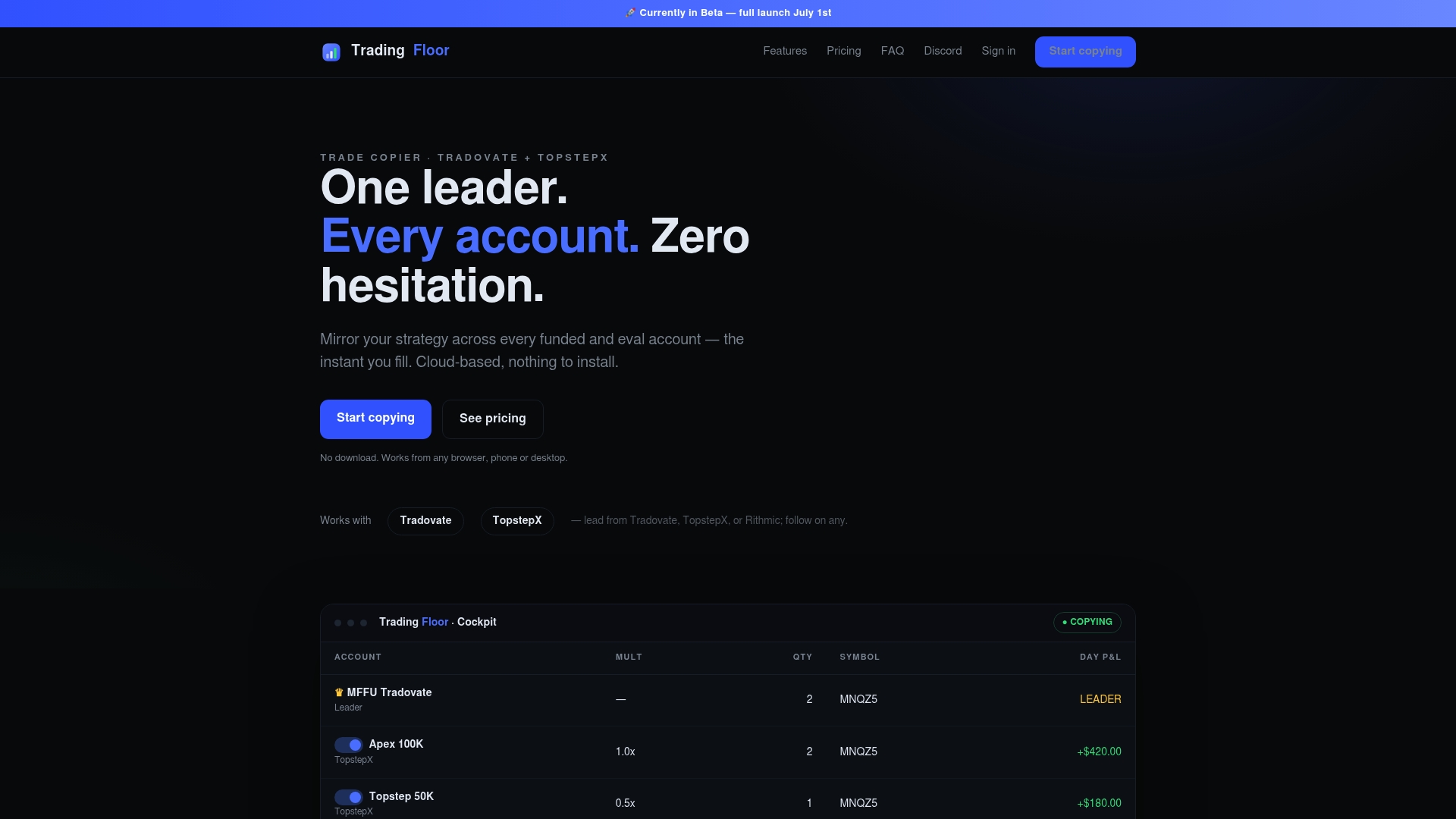
It runs entirely in your browser or on iOS, with no installation and OAuth-based encrypted credentials, and every trade is auditable rather than buried in a broker’s own reporting tool. If you’re managing accounts across Tradovate, TopstepX, or similar platforms, the practical first step is a small proof of concept: route one account through Trading Floor, confirm mirroring and reconciliation behave the way this article describes, then expand from there. Trading Floor offers Starter and Pro plans, starting at $25 per month with no per-account charges, and trading can be paused rather than canceled if you need to step back temporarily. Start with a free trial and see how the same checklist covered above runs on infrastructure built for it.
Sources
- Multi-Broker Automation Scaling: Best Practices — Blog | TradersPost
- Rules | NFA
- FINRA response to comments on proposed rules (2026)
- Risks of automated trading systems — Alpaca Learn
FAQ
What Is the 3-5-7 Rule in Trading?
The 3-5-7 rule is a risk management guideline suggesting no single trade risks more than 3% of capital, total exposure across all open trades stays under 5%, and your most profitable trades should outweigh losers by a significant margin over time. It’s a position-sizing heuristic, not a formal regulatory standard, and traders scaling across multiple accounts often adapt the specific percentages to their own risk tolerance and account structure.
What Is Scale Trading?
Scale trading means running one validated strategy across multiple accounts or brokers simultaneously to increase total capital deployed without changing the underlying logic. Done properly, it relies on consistent allocation rules and independent per-account risk controls, which is the core operational challenge this article addresses.
Is It Possible to Make $1,000 a Day Day Trading?
Daily profit of that scale is possible on some days for well-capitalized, experienced traders, but it isn’t a reliable or repeatable baseline, and most day traders don’t hit it consistently. Outcomes depend heavily on account size, strategy edge, and market volatility on any given day, and scaling across accounts changes the total capital at risk, not the underlying probability of any single day’s result.
Can You Trade With Two Different Brokers?
Yes, trading through two or more brokers simultaneously is legal and common among prop and professional traders diversifying execution venues or managing multiple funded accounts. The operational challenge isn’t permission, it’s coordination: keeping position sizing, risk limits, and reconciliation consistent across brokers with different APIs, fee structures, and margin rules, which tools like Trading Floor are built to manage.
How Do You Keep Risk Consistent Across Different Brokers?
Consistent risk management across brokers starts with treating risk as an aggregate portfolio metric rather than something calculated separately per account. Set exposure caps and allocation rules centrally, then let each broker’s own margin requirements act as a separate, broker-specific constraint layered on top, with daily reconciliation confirming the two stay aligned.
Recommended
- Multi-Platform Trading Best Practices for Prop Traders
- Multi-Account Trade Execution Explained for Prop Traders
- Per-Account Risk Controls: The Role They Play for Multi-Broker Traders
- How to Set Risk Controls Across Multiple Accounts
Trading Floor mirrors every trade across your Tradovate, TopstepX & Rithmic accounts in real time, from $25/mo.
Start copying →