Avoid Double Exposure Copying Before the CFTC Flags Your Prop Firm

Stop duplicated exposure by configuring per-account exclusions or one-to-many netting in your copy software, never leaving two active routes to the same leader. Pair that setup with an auditable allocation record, because CFTC aggregation rules treat commonly controlled accounts as one trader once ownership or control crosses 10%. Copy software designed for prop desks handle both pieces; KennyTrades has watched traders get flagged for skipping the second one.
TL;DR:
- Using per-account exclusions and netting prevents duplicate exposures and helps comply with CFTC aggregation rules, which consider accounts with more than 10% control as one trader.
- Regularly verify and reconcile position sizes, account-specific multipliers, and logs of trade IDs to detect and correct silent reentries caused by partial fill retries or manual account adjustments.
- Configuring copy software for net position mirroring is generally safer for funded accounts, as it reduces drift compared to individual order signal replication that may mismatch timing across brokers.
- Documenting all trades with unique IDs, timestamps, and account details is essential to satisfy NFA fairness rules, especially when monitoring allocation and preventing silent overlaps.
- Tradingfloor automates exclusion and idempotency controls to mitigate duplication risk, providing real-time alerts, audit-ready records, and avoiding manual setup errors that can lead to violations.
Table of Contents
- Two-Minute Checklist to Catch Double Exposure Copying Before It Costs You
- How Do You Configure Copy Software to Prevent Duplicate Positions?
- Why Regulatory Aggregation Rules Make This More Than a Technical Problem
- What Daily Reconciliation Should Actually Look Like
- Common Causes of Double Exposure and How to Fix Them Fast
- Automation Speed vs. Compliance: Why Slower Defaults Win
- How Tradingfloor Handles Duplicate Exposure Risk for You
- Sources
- FAQ
Two-Minute Checklist to Catch Double Exposure Copying Before It Costs You
Run this before every session, not just after something looks wrong. A stuck exclusion list or a stale multiplier is usually the culprit when a funded account shows twice the intended size.
- Scan active copy tasks for duplicate route entries or two leaders pointing at the same follower account.
- Check exclusion lists to confirm evaluation and funded accounts stay separated wherever your firm requires it.
- Verify contract multipliers and per-account lot limits match what each account is actually sized for.
- Turn on real-time alerts for partial fills and rejections, since a silent rejection on one account is how positions drift out of sync.
- Reconcile net position across every linked account against your leader’s net size, symbol by symbol.
Pro Tip: Run the reconciliation step manually once a week even if your software automates it. Automated checks miss the edge case where a manual trade in a follower account quietly doubles up with a copied one.
How Do You Configure Copy Software to Prevent Duplicate Positions?
Start by deciding whether you need net position mirroring or signal replication. Mirroring copies the leader’s net position, so if the leader is flat, followers go flat too, which is the safer default for most funded accounts. Signal replication copies each individual order instead, and it’s more prone to drift when fills happen at different speeds across brokers like Tradovate or TopstepX. For multi-account prop setups, net mirroring is almost always the better choice.
Build your exclusion and inclusion lists early, before you connect a second account:
- Exclude evaluation accounts from any leader that also feeds funded accounts, unless your firm explicitly allows mixed copying.
- Exclude backup or dormant accounts you’re not actively trading, so a forgotten connection can’t silently double a position.
- Set contract multipliers per account rather than relying on a single global ratio, especially when account sizes differ.
- Avoid percentage-of-master or PAMM-style sizing unless you fully understand the rounding and allocation math. This is where over-allocation quietly creeps in.
Idempotency matters more than most traders realize. Every copied order needs a unique trade ID tied to a copy ID, so a retry after a rejected or partial fill doesn’t get replayed as a brand-new order. When a fill comes back partial, the system should adjust the remaining size against that same ID, not fire a fresh order. The Tradovate API exposes granular position and fill data specifically so reconciliation tools can match against these unique IDs across accounts.
Log at least these fields with every copy: order ID, copy ID, timestamp, leader net size, and the resulting follower size. That log is what turns a “trust me, it’s fine” setup into one you can actually defend.

Why Regulatory Aggregation Rules Make This More Than a Technical Problem
Duplicated exposure isn’t just sloppy. It can push you over a position limit you didn’t know you were sharing. The CFTC treats multiple accounts under common ownership or control as a single trader for speculative position limits, and that aggregation kicks in once someone holds a 10% or greater financial interest across those accounts.
17 CFR Part 150 under the eCFR spells out the same 10% threshold and allows exemptions, but only with documented, enforced separation between accounts, things like independent systems and no shared personnel. A copier that quietly duplicates a position across two accounts you control makes that separation argument much harder to defend.
The NFA layers on a separate obligation around fairness. Its guidance on bunched orders requires allocation to be fair and equitable over time, not perfect on every single fill, and it requires recordkeeping to prove that pattern.
The 10% rule in practice: cross a 10% ownership or control interest across accounts, and the CFTC no longer sees separate traders. It sees one position, subject to one limit.
Exchange Market Regulation Departments add their own layer. They convert related options and futures positions into futures-equivalent holdings for aggregation purposes and can request copies of any exemption filings you hold. If your setup is unusual enough that you’re relying on a disaggregation exemption, talk to a compliance professional before you lean on it. Read more on how exchange aggregation rules apply to US copy trading if you’re structuring accounts across multiple firms.
What Daily Reconciliation Should Actually Look Like
A reconciliation habit beats a perfect algorithm. Compare these fields across every linked account, every session: symbol, trade ID, side, size, timestamp, and account ID.
- Pull net position per account from your broker’s API or dashboard.
- Match each position against the leader’s net size, adjusted for that account’s multiplier.
- Flag any mismatch immediately rather than at end of day, since duplication compounds fast in fast markets.
- Archive the day’s reconciliation output as part of your audit trail.
- Review allocation fairness quarterly, and keep those review results on file, consistent with NFA guidance on periodic allocation reviews.
Pro Tip: Save PDF snapshots of any regulatory guidance you rely on. Federal sites rate-limit automated access, and you don’t want to be scrambling for a source during an audit.
Set real-time alerts for multi-account discrepancies so a mismatch surfaces in minutes, not at your next manual check.
Common Causes of Double Exposure and How to Fix Them Fast
Most duplication traces back to one of five habits, and each has a quick fix:
- Overlapping leader assignments — two copy tasks pointed at the same follower account. Audit your task list weekly.
- Idempotency failures on partial fills — a retry fires as a new order instead of adjusting the original. Confirm your software tags every retry with the original trade ID.
- PAMM-style over-allocation — percentage-of-master sizing rounds up across too many accounts. Switch to fixed multipliers where possible.
- Manual trades colliding with copied ones — a trader manually adjusts a follower account mid-copy. Lock manual trading on any account under active copy, or build in a hard guardrail.
- No rollback plan — when duplication happens anyway, flatten the affected account first, then reconcile before resuming copying.
Automation Speed vs. Compliance: Why Slower Defaults Win
Regulators judge allocation fairness over time, not fill by fill, which means a conservative default (mirror net position, exclude aggressively, log everything) beats a faster setup optimized for perfect parity on every trade. When your exclusion rules or multiplier math is ambiguous, default to the safer, more auditable option and adjust later. For advanced patterns like closing-mode exclusions and dynamic multiplier scaling, see Tradingfloor’s guide on excluding accounts from copying.
— KennyTrades
How Tradingfloor Handles Duplicate Exposure Risk for You
Building exclusion logic and idempotent trade IDs by hand is exactly the kind of manual work that introduces the duplication errors this article just walked through. Tradingfloor is built to remove that risk at the account level, not just flag it after the fact.
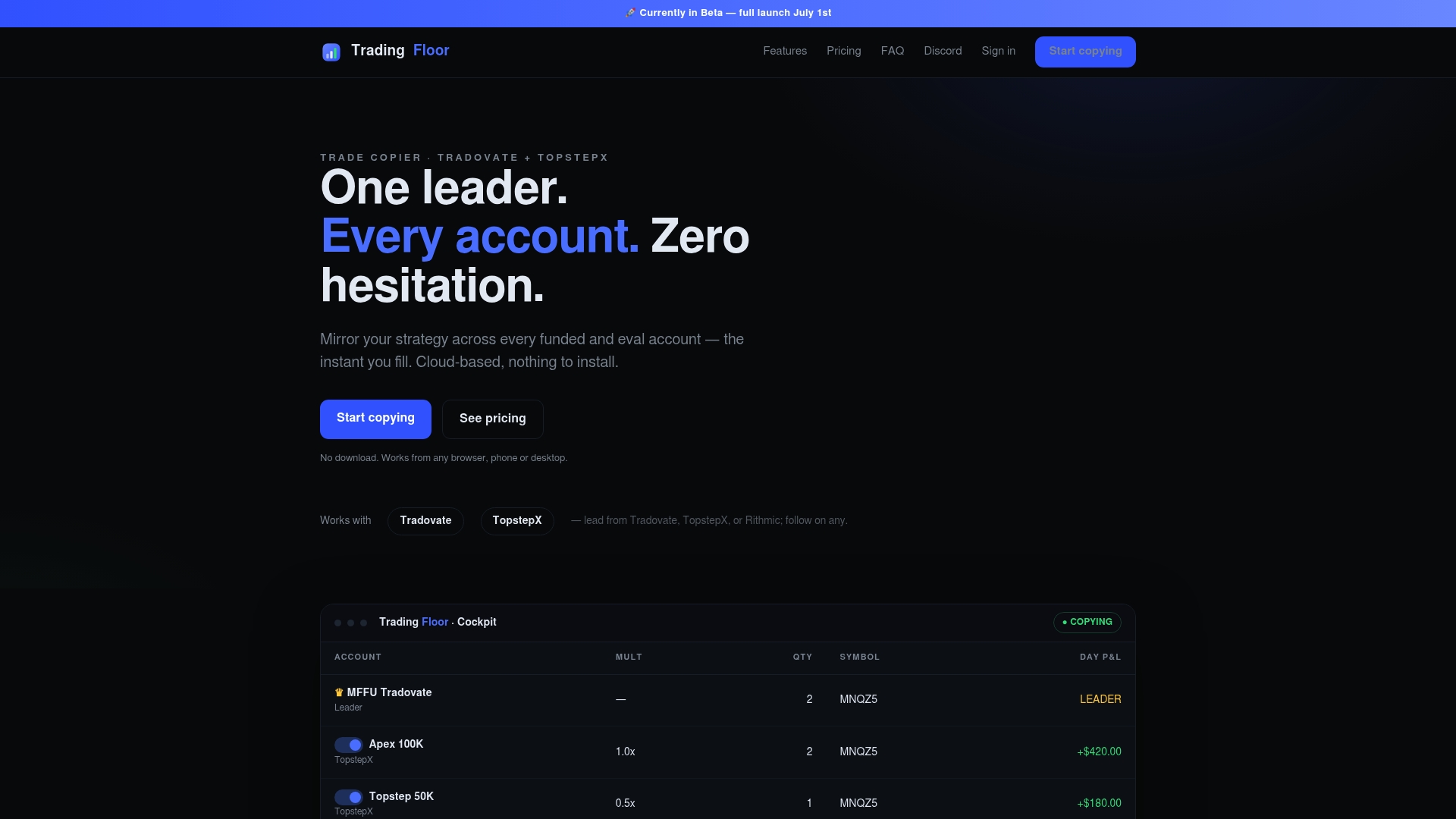
The platform mirrors a leader’s net position rather than replaying individual signals, with per-account risk controls, contract multipliers, and exclusion settings you set once and trust. Every copy generates a real-time notification and an audit-ready receipt, so when a quarterly allocation review comes around, you already have the records the NFA expects to see. It runs entirely in the browser or the iOS app, no installation, connecting across Tradovate, TopstepX, and other supported platforms. Trading Floor’s pricing page lists the Starter plan at $25 per month or $250 per year, and the Pro plan at $50 per month or $500 per year, both following a 30-day free trial. If you’re running a Tradovate setup specifically, check the platform’s dedicated integration page before your next funded evaluation.
Sources
FAQ
What Does Double Exposure Copying Mean for Prop Traders?
It means a trade-copy setup accidentally creates more market exposure than intended, either by duplicating a position across accounts or by triggering regulatory aggregation under the CFTC’s 10% ownership rule. The fix is per-account exclusions, netting, and an auditable allocation trail.
How Do I Prevent Duplicate Positions When Copying Trades?
Configure exclusion lists so evaluation and funded accounts don’t share a leader unnecessarily, use net position mirroring instead of signal replication, and tag every order with a unique trade ID to block replayed fills. Some copy software builds these controls directly into their per-account risk settings.
Does Copying Trades Across Accounts Trigger CFTC Aggregation Rules?
It can, if the accounts are under common ownership or control at 10% or more, which the CFTC treats as a single trader for position limit purposes. Documented separation or a filed exemption under 17 CFR Part 150 is the only way around it.
What Records Do I Need to Prove Fair Allocation?
Keep trade ID, timestamp, symbol, side, size, and account ID for every copied order, plus quarterly allocation fairness reviews, consistent with NFA recordkeeping guidance. Regulators judge fairness over time, not on a single trade.
How Much Does Tradingfloor Cost?
Tradingfloor’s Starter plan runs $25 per month or $250 per year, and the Pro plan runs $50 per month or $500 per year, both after a 30-day free trial listed on the pricing page. Current pricing details are always available directly on the site.
Recommended
- Exchanges, Not CFTC: How US Prop Traders Make Copy Trading Compliant
- Prop Firms That Allow Copy Trading (2026) — the actual rules, sourced
- Stop Accidental Copies: 5 Steps to Exclude Accounts for Prop Traders
- Prop Traders: Audit Proof Entry Only Copying Across 5 Funded Accounts
Trading Floor mirrors every trade across your Tradovate, TopstepX & Rithmic accounts in real time, from $25/mo.
Start copying →