How to Attach Followers to an Open Mid-Position Safely

Yes, you can attach follower accounts to mirror a position that’s already open, but only if your copier supports baselining and per-account risk controls. Skip either one and you risk a follower duplicating a trade the moment it connects, which on a funded account can mean an instant breach of daily loss limits.
Before you touch a single setting, run through this:
- Confirm your copier has a baselining mode (sometimes called “copy existing” vs. “new trades only”) so followers snapshot the leader’s current position instead of blindly replaying history.
- Set a per-account multiplier or RISK_PERCENT value on every follower before you flip copying on, not after.
- Run a small verification trade or a dry-run/demo pass first to confirm the follower’s fill matches the master’s net position.
Prop-firm evaluation and funded programs often restrict account linking or treat duplicated position sizing as a rule violation. Read your firm’s copy-trading policy before you attach anything, and never assume a copier’s default settings are compliant with your specific program.
Key Takeaways
Attaching followers to an already-open position is safe only when your copier baselines the existing trade and applies per-account risk controls before copying begins.
| Point | Details |
|---|---|
| Verify baselining first | Confirm the copier snapshots the master’s open position before any follower connects. |
| Set per-account sizing | Apply a multiplier or RISK_PERCENT value tailored to each account’s equity and rules. |
| Test on demo before live | Run a demo attach and a small live trade before scaling up your multiplier. |
| Reconcile logs immediately | Compare MasterTicket and FollowerTicket sizes within minutes of attaching. |
| Use Tradingfloor for multi-broker setups | Tradingfloor centralizes baselining, risk controls, and logs across Tradovate, TopstepX, and Rithmic. |
Table of Contents
- What Does It Mean to Attach Followers Mid Position?
- What Do You Need Before Attaching Followers?
- How Do You Attach Followers to an Existing Position?
- Why Does Baselining Prevent Duplicate Copies?
- What Risk Settings Should You Use When Attaching Mid Position?
- How Do You Test an Attach Before Going Live?
- What Goes Wrong When You Attach Followers Mid Position?
- How Do You Safely Detach or Switch Followers?
- Cloud Copier or Local EA: Which Fits Mid-Position Attaches?
- How Does Trading Floor Handle a Mid-Position Attach?
- What Rules Do I Follow When Attaching Mid Position?
- Try Tradingfloor for Your Next Mid-Position Attach
- Sources
What Does It Mean to Attach Followers Mid Position?
Attaching followers mid position means connecting one or more follower accounts to a master (or leader) account while that master already has an open trade, so the followers immediately adopt a matching position sized to their own risk rules. This is different from starting a copier fresh at flat, where there’s nothing to synchronize yet. Here, the follower has to catch up to a live trade without re-executing the master’s entire history.
Traders run into this constantly in multi-account setups. A few common scenarios:
- Promoting a demo strategy to funded status. You’ve been running a strategy live on a demo master and want a newly funded account to pick up the current open trade without waiting for the next signal.
- Adding evaluation accounts mid-session. You pass one evaluation and want to add a second or third account to the same master while a trade is already running.
- Splitting one strategy across accounts with different multipliers. A $50,000 evaluation account might run at a 0.5x multiplier while a $150,000 funded account runs at 1.5x, both mirroring the same open position.
Mid-position attachment only works cleanly when the copier records what the master looked like the instant the follower connected. Miss that baseline and you’re not mirroring a position. You’re duplicating one.
Many funded-account programs have explicit language about linking multiple accounts to a single strategy or signal source. Check your prop firm’s terms before attaching anything, since the mechanics described here assume the firm permits copy trading in the first place.
What Do You Need Before Attaching Followers?
Your master account needs to be capable of publishing its position, either through a native connector, an API token, or an EA running on the terminal. Each follower account needs an active login, trading permissions, and enough margin headroom to accept the incoming order without a margin call.
Beyond account status, compatibility is where most first-time attach attempts stumble. Check these before you connect anything:
- Whether the broker or platform’s API actually supports the account types you’re linking (some evaluation platforms restrict API access entirely).
- Symbol mapping between master and follower, especially prefix or suffix differences a broker adds to ticker symbols.
- Order type behavior. Not every follower platform handles stop-limit or bracket orders the same way the master does.
- Maximum simultaneous open positions allowed on the follower account, particularly relevant for micro vs. mini vs. standard futures contracts.
- Contract multiplier differences between instrument classes on different brokers.
| Platform Type | Common Mapping Issue | Typical Delay Cause |
|---|---|---|
| Tradovate accounts | Contract symbol suffixes on rollover months | API polling interval |
| TopstepX evaluation | Order type restrictions on certain instruments | Broker-side order queuing |
| Rithmic-connected terminals | Prefix mismatches across gateways | Network hop between VPS and broker |
| MT4/MT5-based EAs | Broker-specific suffix (e.g., “.m” or “_i”) | Local EA polling delay setting |
Pro Tip: Always verify symbol mapping and contract size multipliers on a test trade before you attach followers to a live position. A mismatched micro-vs-mini contract size is the single most common cause of a follower opening a position ten times larger or smaller than intended.
How Do You Attach Followers to an Existing Position?
The core sequence is simple: snapshot the master’s current state, choose a copy mode that respects existing positions, apply per-account sizing, confirm symbol mapping, then enable copying.
- Take a snapshot of the master’s open position. Record instrument, size, direction, and average entry price before touching any settings.
- Set the copier mode to respect existing trades. Choose
COPY_EXISTINGif you want the follower to mirror the current position immediately, orNEW_TRADES_ONLYif you’d rather wait for the next fresh signal and avoid any mid-position sizing math. - Define the MasterID or connection string. This links the follower to the correct master, especially important when you’re running more than one strategy across your accounts.
- Choose a LotMode. Options typically include
AS_ORIGINAL(matches master size exactly),MULTIPLIER(scales by a fixed factor), orRISK_PERCENT(sizes based on account equity), a structure common to MT4/MT5-based copier utilities like Copy Trade Ritz Prime Pro. - Enable copying and watch the first fill.
A configuration might look roughly like this:
MasterID: MSTR-EVAL-01
CopierMode: COPY_EXISTING
LotMode: RISK_PERCENT
RiskPercent: 0.75
Once enabled, don’t walk away. Run through a short verification pass:
- Confirm the follower’s opened size matches your intended multiplier or risk percentage, not the raw master size.
- Check the copier’s execution log for rejection or partial-fill warnings.
- Verify no duplicate ticket appears for the same position.
Pro Tip: Use MULTIPLIER on personal accounts where you know your own risk tolerance cold, and RISK_PERCENT on funded or evaluation accounts where the equity base (and therefore your daily loss limit) can shift after every session.
Why Does Baselining Prevent Duplicate Copies?
Baselining records a snapshot of the master’s open positions the moment a follower connects or a new master takes over, so the copier knows not to re-execute trades that are already live. Without it, a copier has no way to distinguish “this position already exists” from “this is a brand-new signal,” and it fires an order it shouldn’t.
Expect a well-built copier to behave like this:
NEW_TRADES_ONLYignores anything currently open and waits for the next signal from scratch.COPY_EXISTINGreads the baseline and opens a matching position sized to your LotMode setting.- After a master takeover, the new master’s existing positions get baselined immediately, so its old trades don’t suddenly replicate across every follower, a rule documented in Trade Copier Ultimate’s ownership and baselining behavior.
- Saved ticket mappings should restore automatically after a restart or reconnect, so a dropped connection doesn’t force a full re-attach.
The first account to actively claim master status locks in persistent ownership. A second account trying to publish as master gets blocked until you explicitly reassign ownership, which is exactly the kind of accidental double-master scenario that causes chaos in a multi-account setup.
Check the copier’s ownership or log banner before you trust an attach. If it doesn’t clearly show which account currently holds master status, don’t assume. Verify it manually against the persistent owner record.
What Risk Settings Should You Use When Attaching Mid Position?
Always pair a mid-position attach with per-account sizing controls and a conservative slippage cap. Attaching without them is how a single master trade turns into five uncoordinated, oversized positions across your funded accounts.
Reasonable starting ranges, adjusted to your own account size and strategy volatility:
- Multiplier: Start around 0.25x to 0.5x on a new evaluation account until you’ve confirmed clean execution, then scale up.
- RISK_PERCENT: For most funded accounts, 0.5% to 1% of equity per trade keeps you well inside typical daily drawdown limits.
- Slippage cap: 2 to 5 ticks on liquid futures contracts; wider on thinner instruments.
- Max concurrent open positions per follower: Cap it explicitly, don’t rely on the platform’s default, especially on smaller evaluation accounts.
Before you flip copying on, run through this toggle checklist:
- Auto-flatten enabled for end-of-day or emergency scenarios.
- Maximum exposure per instrument set below the account’s daily loss limit.
- Individual order size limits set independently from the multiplier, as a hard backstop.
Setting a multiplier too aggressively on a small evaluation account is the fastest way to fail a challenge you were otherwise passing. And RISK_PERCENT without checking the follower’s actual contract sizing can produce a position several multiples larger than you intended, since micro and mini contracts don’t scale the same way across instruments.
How Do You Test an Attach Before Going Live?
Test on demo first, then move to live with the smallest multiplier your copier allows before scaling up. This single habit catches most environment and symbol-mapping problems before they cost real money, a workflow echoed in Topstep-focused copier setup documentation.
Pre-live checklist:
- Attach on a demo or sim account and confirm the baseline snapshot matches the master exactly.
- Execute one small test trade and watch it flow through end to end.
- Reconcile ticket numbers and position sizes between master and follower.
- Check execution latency and slippage in the logs, not just the fill price.
After the attach goes live, verify these four things:
- Net position on the follower matches the expected size relative to the master.
- Average entry price is within an acceptable slippage band.
- Open P&L reflects the correct position, not a duplicate or partial one.
- Order IDs in the reconciliation log tie back cleanly to the master’s ticket.
A useful reconciliation log captures, at minimum: MasterTicket, FollowerTicket, Instrument, Size, Price, and Timestamp. Keeping that record isn’t busywork. It’s the only way to prove, after the fact, exactly what happened if a follower’s fill looks off.
What Goes Wrong When You Attach Followers Mid Position?
Most attach failures trace back to one of three things: symbol mismatches, contract-size differences, or confusion over which account currently owns master status, a pattern consistent with common trade copier missed-trade troubleshooting.
| Problem | Likely Cause | Fix |
|---|---|---|
| Missing symbol mapping | Broker uses a different ticker format | Manually map symbols before enabling copy |
| Partial fills on follower | Liquidity gap or slippage cap too tight | Widen slippage tolerance slightly, recheck instrument liquidity |
| Blocked master | Another account already claimed master status | Explicitly reassign ownership before retrying |
| Prefix/suffix mismatch | Broker appends rollover or account suffixes | Update mapping table with correct suffix pattern |
| Account disabled | Follower login expired or lost trading permission | Reauthenticate and confirm permissions before re-attach |
If you find yourself mid-incident, the recovery sequence is short: stop copying immediately, reconcile the ticket map against both accounts, close or manually remap any mismatched positions, then re-attach using NEW_TRADES_ONLY if you’re not confident the baseline is clean.
Pro Tip: Filter your logs by rejection code first, then by fill timestamp. Rejections point to symbol or permission issues; delayed timestamps point to latency; partial fills usually point to liquidity or slippage settings, not the copier itself.
How Do You Safely Detach or Switch Followers?
Stopping copying cleanly requires a controlled detach, and it’s worth knowing upfront that follower positions stay open unless you close them yourself. A copier disconnecting doesn’t flatten anything automatically.
For an emergency stop:
- Enable the copier’s global pause or flatten function if you need everything closed immediately.
- Disable the follower account’s connection rather than deleting it, so you preserve the ticket history.
- Revoke the API connection or token if you’re changing brokers or credentials.
- Use the copier’s dedicated emergency-stop control if one exists, rather than closing the platform outright.
When you’re switching to a new master account, the new master’s existing positions get baselined automatically, echoing the same safer master switching behavior described earlier, so its prior trades won’t suddenly cascade across your followers.
If you intend to fully switch strategies, close follower positions deliberately first. Leaving them open under a new, unrelated master creates a mismatch between what your followers are holding and what the new signal source is actually trading.
Cloud Copier or Local EA: Which Fits Mid-Position Attaches?
A cloud-based copier removes the need for a dedicated VPS and simplifies linking accounts across multiple brokers, while a local EA on a VPS can offer lower latency or broker-specific features for a single-broker setup.
The tradeoffs break down like this:
- Reliability: Cloud platforms typically run with monitored uptime; a local VPS depends on you catching outages yourself.
- Multi-broker support: Cloud solutions generally handle Tradovate, TopstepX, and Rithmic-based accounts under one dashboard; local EAs usually specialize in one platform.
- Latency: Local EAs can shave milliseconds if you’re colocated near the broker’s servers; cloud adds a small network hop but is often negligible for swing or intraday futures trading.
- Maintenance: A local setup (per documentation on local vs. online copy modes) means you manage updates and VPS uptime yourself; cloud platforms handle that centrally.
- Visibility: Cloud dashboards tend to centralize logs and notifications across every linked account, which matters when you’re managing several funded accounts at once.
If you’re running one broker and chasing every possible millisecond, local might win. If you’re managing multiple funded and evaluation accounts across different brokers and need centralized oversight, cloud is the more practical route.
Pro Tip: For prop operations juggling more than two or three accounts, the administrative overhead of managing separate local EAs quickly outweighs any latency edge. Centralized logs save far more time than they cost in milliseconds.
How Does Trading Floor Handle a Mid-Position Attach?
Tradingfloor is built specifically for this workflow: cloud-based mirroring with baselining, per-account risk controls, auto-reconciliation, and real-time notifications, all without installing anything locally.
What it actually does for a mid-position attach:
- Baselines the master’s current position the moment a follower connects, so nothing gets duplicated on attach.
- Supports both multiplier and RISK_PERCENT sizing per follower account.
- Applies slippage caps you set per account, not a single global default.
- Connects across Tradovate, TopstepX, and Rithmic-based accounts without separate VPS instances for each.
- Logs every fill in real time so you can reconcile master and follower tickets without cross-referencing multiple platforms.
To try it on a live mid-position scenario:
- Create a group and designate your master account.
- Set a per-account multiplier or RISK_PERCENT value on each follower.
- Enable baselining before connecting any follower.
- Run a demo attach first and confirm the snapshot matches.
- Check the real-time logs to verify sizing, fills, and timestamps line up.
A clean attach isn’t the one that happens fastest. It’s the one you can fully verify in the logs five minutes later.
What Rules Do I Follow When Attaching Mid Position?
I only attach followers mid position during calmer market conditions, never in the middle of a fast-moving session where a slippage spike could distort the baseline snapshot. Volatility makes verification harder, and verification is the entire point of this exercise.
Three rules I don’t skip, regardless of how confident I am in the setup:
- Demo first, every time. Even on a strategy I’ve run for months, a new account pairing gets a demo pass before it touches real capital.
- Conservative multiplier on the first live attach. I’d rather scale up after confirming clean fills than scale down after a bad one.
- Reconcile tickets within minutes, not hours. If the master and follower sizes don’t match within a few minutes of attaching, something’s wrong, and waiting only compounds the exposure.
These rules exist because funded and evaluation accounts don’t give you room for a do-over. A single oversized fill from a bad multiplier can end a challenge that took weeks to build. The discipline isn’t about being cautious for its own sake. It’s about treating every attach as a moment where a small mistake has an outsized cost.
Try Tradingfloor for Your Next Mid-Position Attach
Tradingfloor runs on a 30-day trial, with onboarding built around the exact steps covered above: create a group, designate a master, set per-account sizing, and confirm baselining before you go live.
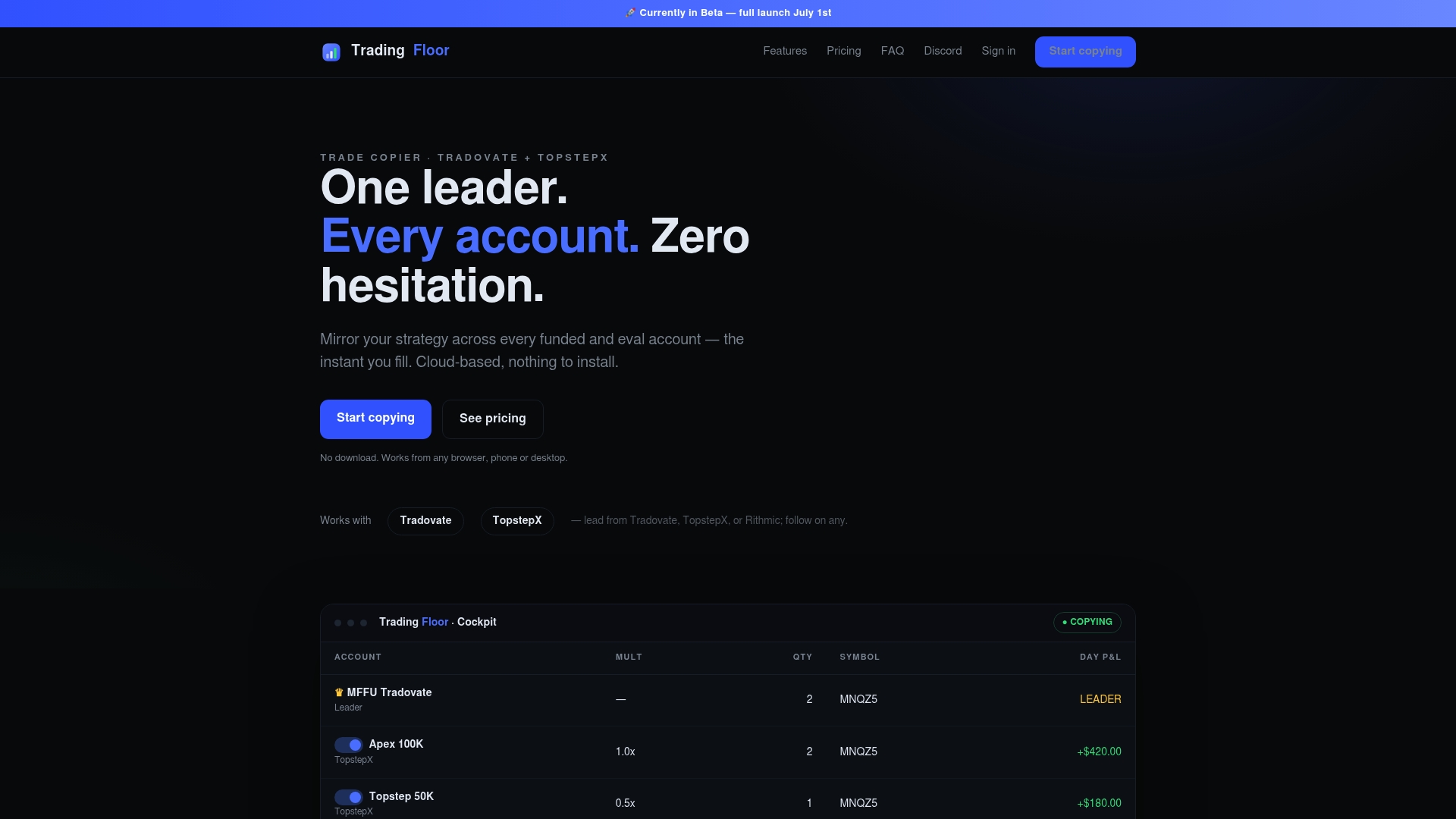
What separates it from stitching together local EAs across separate VPS instances is the centralized view. One dashboard shows every linked account’s fills, slippage, and reconciliation status in real time, across Tradovate, TopstepX, and Rithmic-connected brokers, without you juggling separate log files for each. If you’re managing more than a couple of funded or evaluation accounts, that visibility alone cuts down the time spent chasing down a mismatched fill after the fact.
Start with the Lucid Trading Trade Copier setup if that’s your platform, run the demo attach first, and check the logs before committing real size. That’s the whole point of testing it this way: you find out if it works before it matters.
Sources
These sources cover the technical details behind trade copier configuration, baselining behavior, and platform-specific setup steps referenced throughout this guide.
- How to Use a Trade Copier for Tradovate Accounts
- Topstep Trade Copier for NinjaTrader (2026 Setup Guide)
Keep these bookmarked if you’re debugging a specific platform quirk. Most mid-attach issues trace back to a detail one of these sources documents explicitly.
This article is general information, not a substitute for advice from a qualified financial advisor. Consult a qualified financial professional about your own circumstances before acting on anything here.
Recommended
- Net Position Tracking in Trading: A 2026 Guide — Trading Floor
- Prop Trading Leader Accounts: What Funded Traders Need to Know — Trading Floor
- How to Mirror Trades Across Prop Accounts Precisely — Trading Floor
- Evaluation Account Management Best Practices for Prop Traders — Trading Floor
Trading Floor mirrors every trade across your Tradovate, TopstepX & Rithmic accounts in real time, from $25/mo.
Start copying →