4 Mobile Steps to Test Cloud Trade Copying for Multi Account Traders

Yes, mobile trade copying works, and the reliable method for multi-account, real-time copying is a cloud-based mobile-first trade copier that mirrors net positions rather than raw signals. This approach keeps latency low, runs even when your phone doesn’t, and gives you per-account risk controls you can check from your pocket. A cloud-based trade copier is built around exactly this job for traders juggling funded and evaluation accounts.
TL;DR:
- Cloud-based mobile trade copying ensures continuous, low-latency position mirroring even if your phone is off or signal drops, reducing single-device failure points.
- Key features include clear account toggles, quick risk adjustments, accurate trade logs, and real-time execution timestamps to promptly detect lag or discrepancies.
- Compatibility with popular platforms like MT4/MT5, cTrader, and supported broker accounts is essential, especially for funded and evaluation accounts that may have restricted API access.
- Proper setup involves testing connection and execution during slow market periods, setting risk limits beforehand, and using minimal permissions to safeguard your capital.
- Security measures such as two-factor authentication and encrypted API storage are critical, and effective mobile alerts help monitor liquidations, margin calls, or disconnections without noise.
Table of Contents
- What Mobile Trade Copying Features You Actually Need
- Cloud Engine or Device-Based Copier: How Mobile Copying Actually Works
- Which Platforms and Account Types Should You Check First?
- How to Connect and Test Mobile Trade Copying Safely
- Risk Controls You Need to Configure and Watch From Your Phone
- Monitoring and Alerts: What to Watch From Your Phone
- Mobile Trading Rituals That Prevent Costly Mistakes
- How Tradingfloor Handles Mobile Multi-Account Copying
- Data Usage and Bandwidth on Mobile Trade Copying
- Does Phone Performance Affect Trade Copying?
- Troubleshooting Common Mobile Trade Copying Problems
- Author Perspective: When Mobile Oversight Makes Sense
- Tradingfloor: A Direct Path to Mobile Multi-Account Copying
- Sources
- FAQ
What Mobile Trade Copying Features You Actually Need
A phone screen forces trade-off decisions a desktop platform never has to make. The features that survive that squeeze are the ones worth paying for.
Your account list should show every connected account at a glance, with a toggle to enable or disable copying on any single one without touching the rest. Per-account multipliers need to sit one tap away, not buried three menus deep, because sizing is the first thing you adjust when an account’s risk profile changes mid-session. Trade logs matter more on mobile than anywhere else, since you’re rarely staring at a live chart when a fill happens.
Order controls worth checking before you commit:
- Slippage tolerance settings per account, not just globally
- Partial-fill handling so you know exactly what filled and what didn’t
- Trailing stop visibility and adjustment
- One-tap cancel on pending orders across all copied accounts
Execution timestamps down to the second let you reconcile what your leader account did against what each follower copied, which is the only way to catch a lagging fill before it costs you. Look for browser access as well as a native app. Some traders prefer the app for push notifications; others want browser access so they’re not tied to one device. Dark mode and clean notification grouping sound cosmetic until you’re checking positions at 6 a.m. before market open.
Pro Tip: Test the trade log export function before you fund a live account. If you can’t pull a clean record of every copied fill with a timestamp, you’ll struggle to reconcile discrepancies later.
Cloud Engine or Device-Based Copier: How Mobile Copying Actually Works
Not all “copy trading” apps do the same thing, and the distinction decides whether your positions actually match your leader’s.
Retail social trading apps typically copy signals or a percentage allocation from a chosen provider. Multi-account futures copiers do something different: they mirror the leader’s net position across every connected account, adjusted by whatever multiplier you’ve set. That difference matters when you’re running the same strategy across three funded accounts and need position sizes to scale correctly, not just direction.
Cloud-based copiers run continuously, which means copying continues even if your phone is off, the app got killed by the operating system, or you lost signal on the subway. A copier that lives entirely on your device stops the moment your device does. That’s the core weakness of device-based copying: your phone becomes a single point of failure for every account you’re supposed to be protecting.
Architecture that typically supports this reliability includes:
- An always-on server-side execution engine, independent of any single device
- Broker API connections with defined permission scopes
- WebSocket or similar streaming connections for real-time updates rather than periodic polling
Broker API permissions and order routing are often the hidden variable behind copy slippage. Two copiers can look identical in the app store and perform very differently depending on what order types the API actually allows.
Which Platforms and Account Types Should You Check First?
Before you sign up for anything, confirm the copier actually talks to your accounts. Compatibility gaps are the number one reason traders abandon a mobile copier after the free trial.
Platforms that matter most for multi-account futures and CFD copying include MT4/MT5, cTrader, Tradovate, TopstepX, and Rithmic based order routing, along with TradingView alert pipelines for traders who trigger copies from custom indicators. Account type matters just as much as platform. Funded accounts and evaluation accounts often carry different broker permission levels than a standard retail account, and some prop firms restrict API access entirely.
Before committing, verify:
- Whether your specific broker or prop firm is listed as directly supported
- Whether evaluation accounts get the same copy functionality as funded ones
- What happens if your firm changes its API policy mid-cycle
How to Connect and Test Mobile Trade Copying Safely
Getting copying live on your phone takes four real steps, and skipping the testing phase is the most common mistake traders make.
- Generate API keys or link your broker with minimal permissions. Grant only what’s needed for order placement and position reading. Never hand over withdrawal-level access to a trade copier.
- Set per-account multipliers and hard exposure limits before connecting anything live. Decide max lots or contracts per account first, not after your first copied trade surprises you.
- Run demo or paper mode first. Watch the execution timestamps and logs on your phone to confirm copies land within the latency you expect, not just that they land at all.
- Go live with minimum size. Copy one micro contract, watch the push notification arrive, then check the fill against your leader account before scaling up.
Pro Tip: Run your live test during a slow market session, not the open. A quiet Tuesday afternoon tells you far more about your copier’s real behavior than a chaotic first five minutes after the bell.
Risk Controls You Need to Configure and Watch From Your Phone
This is the section that actually protects your capital, and it’s the one traders skip fastest when they’re excited to go live.
Set a maximum exposure per account, a daily loss limit, and a drawdown circuit breaker that pauses copying automatically rather than waiting for you to notice. Slippage caps and order expiry rules decide what happens when a fill doesn’t land cleanly. Partial-fill handling should be explicit, not assumed. A one-tap kill switch or pause button needs to sit somewhere you can find it in under three seconds, because the moment you need it is the moment you won’t want to hunt for it.
Between 75% and 95% of retail margin accounts lose money, according to a standard industry risk disclosure figure. Multi-account copying doesn’t change that math. It just multiplies whatever risk discipline, or lack of it, you’re already applying.
Security basics worth confirming before you connect a single account:
- Two-factor authentication on the copier account itself, not just your broker login
- Encrypted storage for API credentials, never plain-text keys
- Short session timeouts on mobile so a lost or stolen phone isn’t a live risk vector
Monitoring and Alerts: What to Watch From Your Phone
Not every notification deserves your attention, and treating all of them equally is how mobile traders burn out fastest.
Prioritize alerts for equity drops past a set threshold, failed executions, API disconnects, and margin calls. Everything else can wait for your scheduled check. Reading an execution log on a small screen gets faster once you know what you’re looking for: timestamp, fill price, and account ID, in that order. Set a personal rule for when a mobile alert means “open the desktop app now” versus “note it and move on.” A disconnected API feed on one account is a desktop-now problem. A single slippage tick on a micro contract usually isn’t.
Aggregated summary notifications, rather than a ping for every single fill, cut down on the kind of noise that leads to emotional overtrading. Grouping alerts by account and by severity keeps your phone useful instead of exhausting.
Mobile Trading Rituals That Prevent Costly Mistakes
Discipline on mobile looks different than discipline at a desk, mostly because the phone is always in your pocket and always tempting a glance.
Traders who manage copied positions well tend to follow a short daily check, roughly 30 seconds, plus a deeper weekly review. That rhythm keeps you informed without inviting the kind of reactive tinkering that turns a normal drawdown into a panic sell. Write down your emergency actions before you need them: what you’ll pause, in what order, and at what threshold. Deciding this in a calm moment beats deciding it while your equity curve is dropping.
Good mobile apps reduce fat-finger errors with confirmation dialogs before order submission and dedicated order tabs separate from your main dashboard. A second device for critical accounts adds a useful layer of redundancy if your primary phone fails mid-session.
Pro Tip: Don’t change strategy parameters, multipliers, or risk settings from mobile if you can avoid it. Use your phone to monitor and intervene, not to redesign your approach on a cramped screen while distracted.
How Tradingfloor Handles Mobile Multi-Account Copying
Tradingfloor mirrors your leader account’s net position across every connected funded or evaluation account, with per-account risk controls set independently for each one. It runs as a cloud application accessible from any device, so there’s nothing to install on your phone. It supports popular platforms directly, and the mobile interface covers trade logs, push notifications, and kill-switch access for exactly the oversight this article describes.
Data Usage and Bandwidth on Mobile Trade Copying
Real-time copying doesn’t demand much data by modern standards, but connection quality matters more than raw bandwidth. A cloud copier streams small, frequent updates, positions, fills, and account status rather than large files, so a stable low-latency connection beats a fast but flaky one every time.
Cellular data usage for a typical trading day running notifications and periodic log checks is modest, usually well under what a single music streaming session consumes. The bigger risk isn’t data cost, it’s connection drops during a critical moment. A subway tunnel or an elevator ride at the wrong second can delay a notification just long enough to matter.
Wi-Fi handoff issues cause more mobile trading friction than actual bandwidth limits. When your phone switches from cellular to Wi-Fi or back, some apps briefly lose their live connection and need a few seconds to reestablish it. That’s rarely a problem for a cloud-based copier, since the copying itself happens server-side regardless of what your phone is doing. It’s only your monitoring view that hiccups, not the actual execution.
If you’re trading from an area with unreliable coverage, consider enabling a data-saver mode if your copier offers one, and lean on push notifications over constant manual refreshing. Refreshing a dashboard repeatedly burns more battery and data than letting alerts come to you.
Does Phone Performance Affect Trade Copying?
Your phone’s hardware doesn’t execute trades in a cloud-based copying setup, the server does that work, but weak device performance still creates real friction. A slow processor or an aging battery can delay how fast you see and react to an alert, even when the underlying copy happened instantly on the server side.
Battery drain is the more practical concern. Constant push notifications, background app refresh, and an always-on screen for chart checking add up over a trading session. Traders running copied positions across several accounts during active hours often report needing a midday charge if they’re checking frequently, something rarely an issue on desktop.
A few habits reduce the strain. Lower your screen brightness and disable unnecessary background apps during trading hours. Use notification grouping so your phone doesn’t wake for every minor update. Keep a charging cable or a portable battery pack accessible if you’re monitoring for a full session, particularly during high-volatility windows when you’ll be checking more often.
Older devices with limited RAM sometimes struggle to keep a trading app running in the background without the operating system killing it to free memory. That matters less for a cloud-based copier, since copying continues server-side regardless, but it matters a great deal for whether you actually see the notification telling you what happened. If your phone is more than a few years old and you’re relying on it for critical account monitoring, a device upgrade is a cheaper insurance policy than most traders assume.

Troubleshooting Common Mobile Trade Copying Problems
Most mobile copying issues trace back to one of a handful of causes, and knowing which one you’re facing saves a lot of frustrated tapping.
Missed or delayed notifications are usually a permissions problem, not a copier problem. Check that your phone’s operating system isn’t restricting background activity or battery optimization for the app, since aggressive power-saving settings on some Android devices silently suppress push notifications. Delayed fills that don’t match your leader’s timestamp point toward broker API rate limits or order routing congestion, not necessarily the copier’s own latency. Check your broker’s status page before assuming the copier failed.
If an account shows as disconnected, the most common cause is an expired or revoked API key, often after a broker-side security update or password change. Reconnecting usually resolves it in minutes, but it’s worth setting an alert specifically for disconnect events so you’re not discovering the gap hours later.
Duplicate or doubled positions on mobile usually happen when a connection drops and reconnects mid-order, causing a retry that the server hadn’t yet confirmed as failed. Good copiers build in reconciliation logic to catch this, but it’s worth manually checking your position sizes against your leader account after any network interruption. When in doubt, pause copying, verify balances across every account from the trade log, then resume once everything reconciles.

Author Perspective: When Mobile Oversight Makes Sense
Mobile-first copying suits prop traders running several funded accounts who need eyes on risk, not a redesign lab in their pocket. If you’re the type who tweaks strategy mid-panic, keep parameter changes on desktop. Start conservative, then scale multipliers once the logs prove the copy is behaving.
— KennyTrades
Tradingfloor: A Direct Path to Mobile Multi-Account Copying
Everything covered above, net position mirroring, per-account risk limits, cloud reliability, mobile alerts, is what this trade copier is built to handle. It runs entirely in the cloud, so there’s no app to install and no device dependency risking a missed copy. Users get real-time mirroring across funded and evaluation accounts, individual risk controls per account, and push notifications the moment something needs attention.
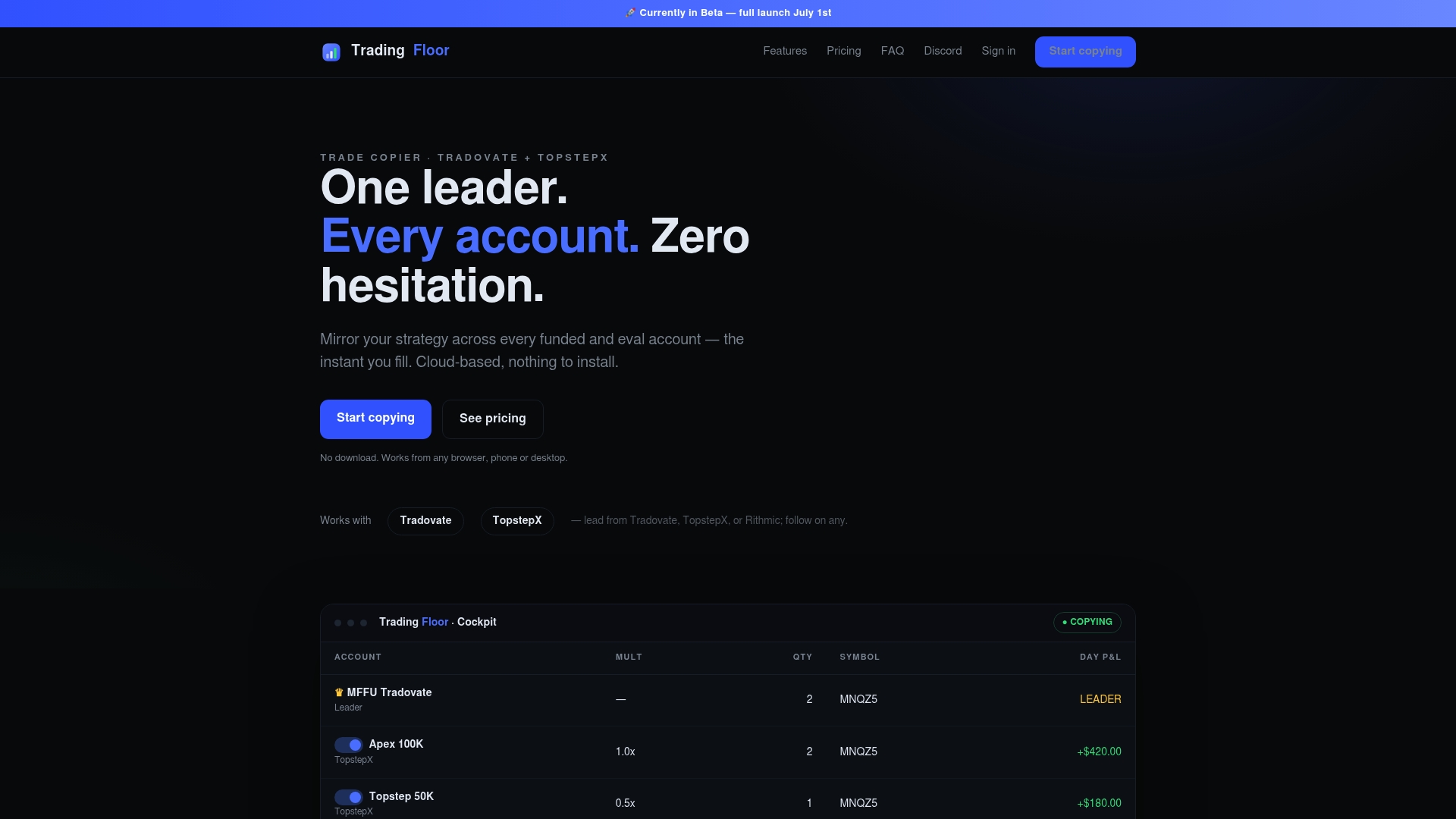
If you’re currently piecing together spreadsheets or manually mirroring trades across Tradovate and TopstepX accounts by hand, that workaround has a ceiling most traders hit fast. Tradingfloor plans start at $25 a month, positioned as a direct alternative to older desktop-bound copiers, and traders running Earn2Trade accounts specifically can check the Earn2Trade-focused setup built for that platform. Start with a trial, connect one account pair, and watch the first few copies land before you scale to your full account list.
Sources
- One data set that warns against margin trading — Anderson Review (UCLA)
- How to avoid a fat-finger blunder — RBC Direct Investing
- Tips for staying disciplined and emotionally balanced on mobile trading apps — FXExplained
FAQ
Can You Use a Trade Copier on Mobile?
Yes. Cloud-based copiers like Tradingfloor run server-side, so your phone acts as a monitoring and control interface while copying continues even when the app is closed.
Is Copy Trading Illegal in the US?
No, copy trading itself isn’t illegal in the US, but the specific service must operate through properly regulated brokers and comply with relevant securities and futures rules depending on the instruments traded.
What Is the Best App for Copy Trading?
It depends on your goal: social signal-following apps suit retail traders copying a single provider, while multi-account futures traders managing funded and evaluation accounts typically need a cloud-based copier built for net-position mirroring and per-account risk controls, which is the category Tradingfloor serves.
Is Copy Trading Really Profitable?
Profitability depends entirely on the strategy being copied and the risk controls applied. Between 75% and 95% of retail margin accounts lose money, so copying a strategy doesn’t remove that risk, it just replicates whatever risk the leader account is already taking.
Recommended
- Trading Account Delegation Best Practices for Prop Traders
- How to Copy Trades Across Multiple Prop Firm Accounts Like TopstepX
- Types of Trade Copying Strategies: 2026 Guide
- Manage Tradovate and TopstepX Accounts Together
Trading Floor mirrors every trade across your Tradovate, TopstepX & Rithmic accounts in real time, from $25/mo.
Start copying →